Who is the biblically accurate Satan? Popular culture pictures a red-skinned devil with horns and a pitchfork, but Scripture paints a very different figure. The Hebrew Bible introduces ha-satan as an adversary or accuser, not a ruler of hell.
In fact, the Bible never gives a full physical description of him. Over time, the New Testament expands this role, describing a deceiver, tempter, and enemy of God’s people. This guide traces the biblically accurate Satan through Hebrew roots, key passages, and theological debates.
You will also see how art, literature, and tradition reshaped his image, and how to separate biblical truth from cultural myth. Along the way, expect clear verses, simple comparisons, and answers to common questions.
Understanding the Biblically Accurate Satan in Scripture
The Bible never gives a full biography of Satan. The biblically accurate Satan emerges from scattered passages across both Testaments.
The Hebrew Concept of Ha-Satan
In Hebrew, satan means “adversary” or “accuser.” With the article, ha-satan means “the adversary,” which works as a title rather than a personal name. This title is the starting point for the biblically accurate Satan.
Defining Characteristics of Ha-Satan:
- Appears in God’s heavenly court in Job 1–2 and Zechariah 3:1–2.
- Accuses humans before God.
- Acts only with God’s permission.
- Numbers 22:22 uses the same word for the angel who blocked Balaam.
Satan’s Transformation Across Biblical Texts
Over time, the figure shifts from a court prosecutor to a cosmic enemy. Second Samuel 24:1 credits God’s anger for David’s census, while the later 1 Chronicles 21:1 says Satan incited it. Tracking this shift helps define the biblically accurate Satan.
Satan’s Evolution Through Scripture
| Stage | Text | Portrayal |
| Court accuser | Job 1–2; Zechariah 3 | Adversary who answers to God |
| Inciter | 1 Chronicles 21:1 | Pushes David to count Israel |
| Tempter | Matthew 4:1–11 | Offers Jesus kingdoms and power |
| Cosmic dragon | Revelation 12:9; 20:2 | Defeated and bound |
Distinct Roles Across Old and New Testaments
The Old Testament shows a limited accuser. The New Testament adds names like “the devil” (diabolos, “slanderer”), “the tempter,” and “ruler of this world” (John 12:31). Together, these roles form the biblically accurate Satan.
Characteristics of the Biblically Accurate Satan
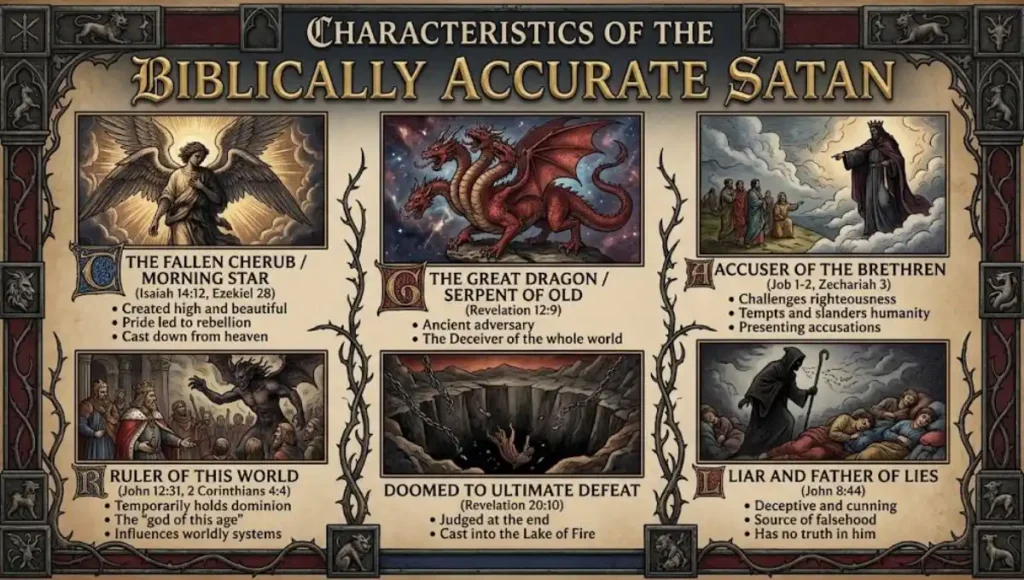
Scripture defines the biblically accurate Satan by what he does, not by how he looks.
Satan’s Functions and Symbolic Significance
Each title reveals a function of the biblically accurate Satan. Together they show an enemy focused on accusation, temptation, and destruction.
Satan’s Symbolic Functions in Scripture
- Accuser: Revelation 12:10
- Tempter: Matthew 4:3
- Deceiver: Revelation 12:9
- Murderer: John 8:44
Biblical Descriptions and Metaphorical Imagery
The Bible uses animal and light imagery for the biblically accurate Satan. It never offers a physical portrait.
Satan’s Appearance Across Scripture
| Image | Verse | Meaning |
| Serpent | Genesis 3:1; Revelation 12:9 | Cunning and deceit |
| Roaring lion | 1 Peter 5:8 | Predatory threat |
| Red dragon | Revelation 12:3 | Destructive power |
| Angel of light | 2 Corinthians 11:14 | Counterfeit goodness |
The Adversary’s Operational Boundaries
The biblically accurate Satan is not God’s equal. He needs permission, and he can be resisted.
Limitations on Satan’s Power:
- Needs God’s permission to touch Job (Job 1:12; 2:6).
- Cannot take Job’s life (Job 2:6).
- Flees when resisted (James 4:7).
- Faces final defeat (Revelation 20:10).
Deception as Primary Tactic
Lies are his main weapon. Jesus calls him “the father of lies” (John 8:44), and Paul warns of his “schemes” (Ephesians 6:11). Deception defines the biblically accurate Satan more than any monstrous look.
Read Also: Coldest Bible Verses: The Most Powerful and Striking Scriptures in the Bible
What Does the Bible Say About Satan’s Appearance?
Does the Bible Describe Satan’s Physical Appearance?
No. No verse gives his height, face, or clothing. Horns, tails, and red skin are later additions, not part of the biblically accurate Satan.
Satan as a Serpent, Dragon, and Angel of Light
Genesis 3 never names the serpent as Satan. Revelation 12:9 makes the link, calling him “that ancient serpent.”
The dragon has seven heads and ten horns (Revelation 12:3). The angel of light shows that he imitates goodness.
Biblical Symbols Associated With Satan
These symbols describe the biblically accurate Satan’s character, not his body.
- Serpent (Genesis 3; Revelation 12:9)
- Dragon (Revelation 12:3)
- Roaring lion (1 Peter 5:8)
- Darkness (Acts 26:18)
- Counterfeit light (2 Corinthians 11:14)
Biblical Versus Cultural Depictions of Satan
Culture shaped the popular image far more than Scripture did. That image often hides the biblically accurate Satan.
Literary and Artistic Influences on Satan’s Image
Major Cultural Influences:
- Dante’s Inferno (c. 1320): a three-faced Satan frozen in ice.
- Milton’s Paradise Lost (1667): a tragic, heroic rebel.
- Medieval art: horns and hooves borrowed from pagan gods like Pan.
- Gustave Doré’s engravings (1860s): dramatic, winged devils.
Historical Development of Visual Representations
Early Christian art rarely showed Satan. The horned, winged devil became common in the Middle Ages. None of it comes from the biblically accurate Satan of Scripture.
Evolution of Satan’s Visual Depiction
| Period | Typical Image |
| Early Christian (2nd–5th century) | Serpent, or barely shown |
| Medieval (500–1400) | Horned beast with claws |
| Renaissance (c. 1500) | Grotesque demons, as in Bosch |
| Modern | Red suit and pitchfork |
Modern Media’s Portrayal of the Adversary
Shows like Lucifer (2016–2021) portray him as a charming nightclub owner. Horror films show a snarling monster.
Neither matches the biblically accurate Satan, who works through quiet deception rather than spectacle.
Key Differences Between Scripture and Culture
Biblical Versus Cultural Satan
| Topic | Bible | Culture |
| Appearance | No description; symbols only | Red skin, horns, tail |
| Hell | Fire “prepared for the devil” (Matthew 25:41) | Satan rules hell |
| Power | Limited by God | Near-equal rival of God |
| Method | Deception and accusation | Dramatic bargains |
The Lucifer Debate: Biblically Accurate Analysis
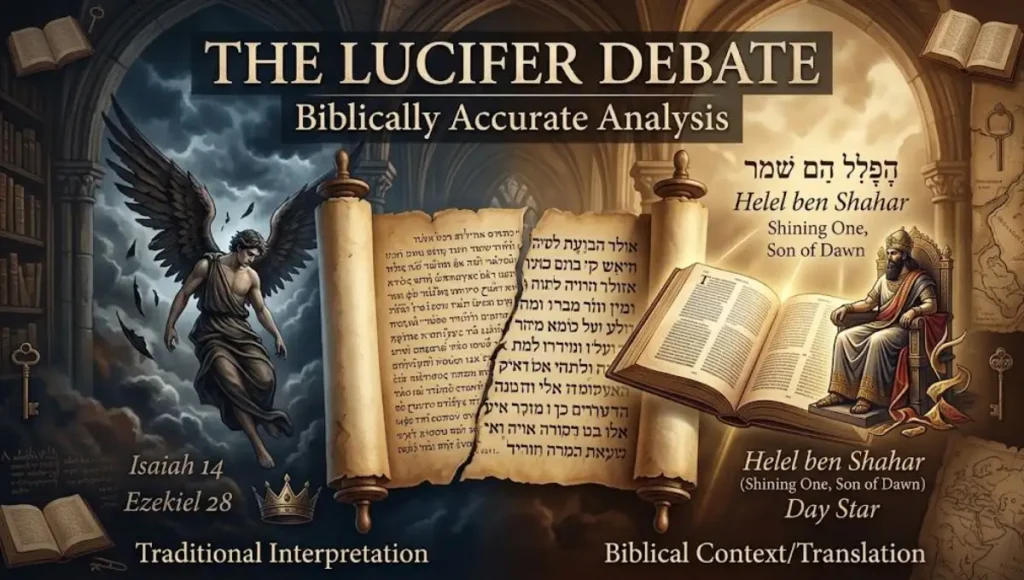
Etymology and Translation History
“Lucifer” is Latin for “light-bringer.” Jerome used it in the Vulgate (c. 400 AD) for the Hebrew word helel in Isaiah 14:12, and the King James Bible (1611) kept it.
Lucifer’s Linguistic Origins:
- Hebrew: helel ben shachar, “shining one, son of dawn.”
- Greek Septuagint: heosphoros, “dawn-bringer.”
- Latin Vulgate: lucifer, “light-bringer.”
Isaiah 14: Addressing Babylon’s King
Isaiah 14:4 introduces the passage as a taunt against the king of Babylon. Nothing in the text names Satan, which matters when defining the biblically accurate Satan.
Isaiah 14 Contextual Evidence
- Verse 4 names “the king of Babylon.”
- Verse 16 calls him a “man.”
- Verses 19–20 describe an unburied corpse.
- Verse 11 mentions worms covering him.
Ezekiel 28: The Tyre Connection
Ezekiel 28 targets the prince and king of Tyre. Some readers see Satan behind the Eden and cherub imagery.
Ezekiel 28 Contextual Markers
- Verse 2: the “prince of Tyre” claims to be a god.
- Verse 12: a lament over “the king of Tyre.”
- Verses 13–14: Eden, jewels, and a guardian cherub.
- Verse 18: fire reduces him to ashes before onlookers.
Development of the Satan-Lucifer Association
Origen (c. 230 AD) and later Augustine linked Isaiah 14 to Satan’s fall, helped by Luke 10:18. By the Middle Ages, the link was standard.
Jesus’s Statement on Satan’s Origin
In John 8:44, Jesus says the devil “was a murderer from the beginning.” He does not explain how or when Satan fell. This is the clearest origin clue for the biblically accurate Satan.
Implications of ‘Murderer from the Beginning’:
- His rebellion likely predates humanity’s fall.
- “Beginning” may point to Genesis 3 or earlier.
- It shows intent to destroy, not only to tempt.
- It does not settle the Isaiah 14 or Ezekiel 28 debate.
Theological Understanding of the Biblically Accurate Satan
Satan’s Function in Biblical Narratives
In every story, the biblically accurate Satan tests, accuses, or tempts. God stays in control throughout.
Satan’s Roles Across Scripture
| Passage | Role |
| Genesis 3 | Deceiver |
| Job 1–2 | Accuser and tester |
| Zechariah 3 | Accuser of Joshua |
| Matthew 4 | Tempter |
| Revelation 12 | Dragon and accuser |
Detailed Examination of Key Passages
A handful of passages shape most of the doctrine.
Critical Passages Revealing Satan’s Nature:
- Luke 10:18: Satan falls “like lightning.”
- 2 Peter 2:4 and Jude 6: angels who sinned.
- Revelation 12:7–9: war in heaven.
- Colossians 2:15: hostile powers disarmed at the cross.
Interpretations Across Christian Traditions
Most traditions see the biblically accurate Satan as a personal, fallen being. They differ on origin and emphasis.
Denominational Perspectives on Satan
| Tradition | View |
| Catholic | Fallen angel, created good (Catechism 391; Lateran IV, 1215) |
| Eastern Orthodox | Fallen angel, defeated by Christ |
| Protestant | Real, personal adversary; emphasis varies |
| Latter-day Saints | Lucifer, a rebellious premortal spirit |
| Christadelphian | No personal devil; Satan means sin and opposition |
Bible Verses About Satan and His Power
Genesis 3: The Serpent’s Deception
The serpent asks, “Did God really say…?” (Genesis 3:1). He twists God’s word instead of denying it.
Job 1-2: Satan’s Limitations
Satan must ask permission twice, and God sets firm limits each time (Job 1:12; 2:6).
John 8:44: Satan as a Liar and Murderer
Jesus calls him a murderer and “the father of lies.” Lies and death mark his work.
1 Peter 5:8: Satan as a Roaring Lion
Peter urges believers to stay alert because the enemy “prowls around like a roaring lion.” The image is a simile, not a physical description.
Revelation 12: The Dragon and the Ancient Serpent
Revelation 12:9 gives four titles: the great dragon, the ancient serpent, the devil, and Satan. It then describes him thrown down to earth. It is the fullest portrait of the biblically accurate Satan.
Ephesians 6:11-12: Spiritual Warfare
Paul says the struggle is “not against flesh and blood.” He urges believers to put on the full armor of God.
Comparative Religious Perspectives on the Biblically Accurate Satan
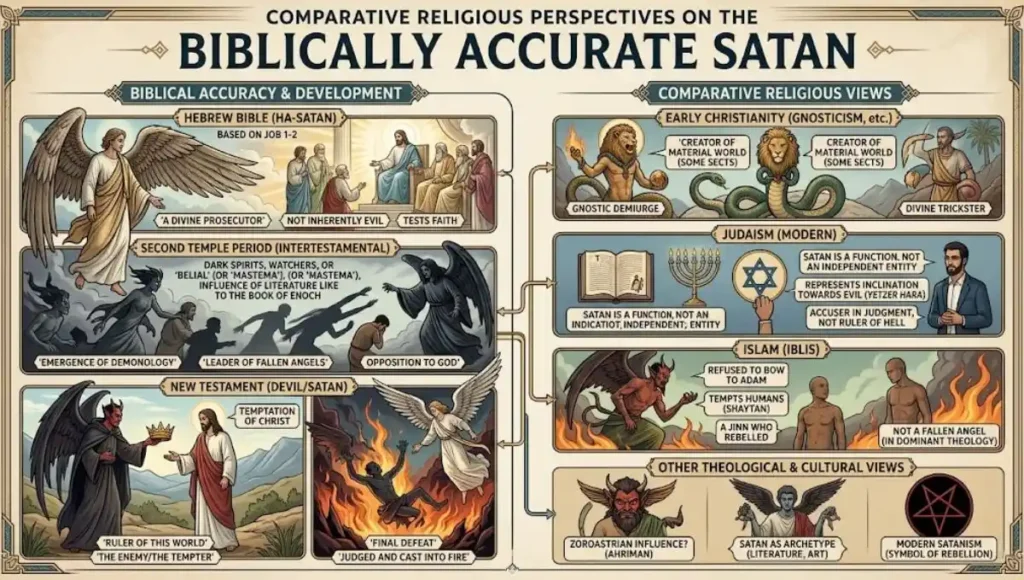
Jewish Understanding of Ha-Satan
Judaism treats ha-satan as a servant in God’s court, not as a rival deity.
Read Also: Biblically Accurate God: Revealing the True Glory Beyond Human Imagination
Jewish Theological Distinctives:
- Works under God’s authority.
- The Talmud (Bava Batra 16a) links Satan, the evil inclination, and the angel of death.
- No standard doctrine of a cosmic fall.
- Focus on the yetzer hara, the inner evil inclination.
Islamic Conception of Iblis
The Quran names Iblis, who refused to bow to Adam (Quran 2:34). He is also called Shaytan.
Islamic Distinctive Features:
- Described as one of the jinn, not an angel (Quran 18:50).
- Fell through pride, not lust or rebellion alone.
- Whispers to humans but cannot force them.
- Granted respite until the appointed time (Quran 15:36–38).
Cross-Tradition Comparative Analysis
Satan Across Abrahamic Faiths
| Faith | Name | Origin | Role |
| Judaism | Ha-Satan | Angel in God’s court | Accuser, tester |
| Christianity | Satan, Devil | Fallen angel (most views) | Tempter, deceiver |
| Islam | Iblis, Shaytan | Jinn | Whisperer, misleader |
Zoroastrian Influence on Development
Some scholars point to Persian dualism after Babylon fell in 539 BCE. In it, Angra Mainyu opposes the good god Ahura Mazda.
Others argue Jewish ideas about the biblically accurate Satan developed independently.
Scholarly Debate: Satan’s Angelic Origin
Traditional Fallen Angel Position
The church has long taught that the biblically accurate Satan fell from heaven through pride.
Evidence for Fallen Angel View
- Luke 10:18
- Revelation 12:7–9
- 2 Peter 2:4 and Jude 6
- 1 Timothy 3:6: pride and “the condemnation of the devil.”
Alternative Created Adversary View
Others argue the texts never describe a fall. In their view, the biblically accurate Satan was always God’s adversary-servant.
Arguments for Created Adversary Position:
- Isaiah 14 and Ezekiel 28 address human kings.
- No verse says when or how Satan fell.
- Job places him inside God’s court.
- Elaine Pagels’ The Origin of Satan (1995) traces the figure’s historical development.
Theological Implications of Each Perspective
Each view shapes how believers understand evil and God’s sovereignty.
Implications of Origin Theories
| View | Implication |
| Fallen angel | Evil began as a free choice by a good creature |
| Created adversary | The adversary serves God’s purposes from the start |
Tradition Versus Textual Analysis
Tradition reads several passages together. Textual analysis reads each in its own setting.
Both approaches accept that the New Testament presents Satan as a real adversary.
Practical Applications for Believers
The origin debate is interesting. The New Testament, however, stresses practical steps for facing the biblically accurate Satan: resist, stay alert, trust Christ.
Practical Impact on Faith:
- Take the threat seriously without living in fear.
- Test every teaching against Scripture.
- Do not blame Satan for every problem.
- Rely on Christ’s victory (1 John 3:8).
Cultural Impact of the Biblically Accurate Satan
Belief in the biblically accurate Satan shapes worship, media, and mental health.
Influence on Religious Practices
Denominational Worship Practices
- Catholic and Orthodox baptism include renouncing Satan.
- The Catholic Rite of Exorcism was revised in 1999.
- Pentecostal churches often practice deliverance ministry.
- Many Protestant churches stress prayer and Scripture.
Spiritual Warfare Approaches
Varied Spiritual Warfare Models:
- Defensive: the armor of God (Ephesians 6).
- Confrontational: deliverance and rebuking prayers.
- Sacramental: exorcism and blessings.
- Pastoral: counseling alongside medical care.
Contemporary Cultural Manifestations
Satan in Modern Media
- Horror films like The Exorcist (1973).
- Series like Lucifer (2016–2021).
- Halloween costumes and memes.
Psychological Effects of Satan Belief
Psychological Impact of Satan Belief:
- A 2007 Gallup survey found 70% of Americans believed in the devil.
- It can build moral vigilance.
- It can also cause fear, guilt, or blame-shifting.
- Mental illness should never be dismissed as demonic. Seek medical help too.
How to Recognize Satan’s Deception According to the Bible
The biblically accurate Satan works mainly through lies, so discernment matters.
Biblical Warnings About Falsehood and Temptation
Second Corinthians 11:14 says Satan “disguises himself as an angel of light.” In Matthew 4, he even quotes Scripture out of context.
Jesus answered each time with “It is written.” Truth, not volume, defeats deception.
Discernment Through Scripture and Prayer
- Test every spirit (1 John 4:1).
- Know Scripture well (Matthew 4:4).
- Pray persistently (Ephesians 6:18).
- Seek wise counsel (Proverbs 11:14).
Understanding the Difference Between Symbolism and Literal Claims
Revelation’s dragon is symbolic imagery. Yet the New Testament also speaks of a real adversary. Reading each passage by its genre keeps the biblically accurate Satan in focus.
Read Also: 45 Bible Verses About Baseball: The Christian Life Lessons Within
Synthesizing the Biblically Accurate Satan
The biblically accurate Satan is an accuser, tempter, and deceiver with limited power. The Bible gives no physical portrait, only symbols.
Art and media added the horns, tails, and red skin. Scripture adds something more useful: a clear warning and a clear victory.
Frequently Asked Questions
What does a Biblically accurate angel look like?
Often like an ordinary man (Genesis 18; Hebrews 13:2). Ezekiel 1 describes cherubim with four faces and wheels of eyes.
What does Biblically accurate Satan look like?
The Bible gives no physical description. It uses symbols: a serpent, a dragon, a lion, and an angel of light.
What does Biblically accurate God look like?
No one has seen God (John 1:18). Ezekiel 1:26 describes only a human-like figure on a throne, glowing like fire.
What does a Biblically accurate demon look like?
Scripture never describes demons’ bodies. They appear as unclean spirits recognized by their effects, not their looks.
What does Biblically accurate Jesus look like?
Isaiah 53:2 says he had no striking beauty. He was a first-century Galilean Jewish man, likely olive-skinned with short hair.
What does Biblically accurate heaven look like?
Revelation 21 describes a cube-shaped city about 12,000 stadia wide, with gold streets and twelve pearl gates.
What does a Biblically accurate seraphim look like?
Isaiah 6:2 describes six wings: two cover the face, two cover the feet, and two are for flying.
Conclusion
The biblically accurate Satan is defined by his actions: accusing, tempting, and deceiving. He is powerful but always limited by God.
To understand the biblically accurate Satan, read the texts in context, separate symbol from tradition, and measure every claim against Scripture.

Abdul Mannan Haider is a content writer at [InspiredMsg.com], specializing in Messages and Prayers. With 5 years of experience, he creates meaningful, engaging, and easy-to-read content that connects with readers.