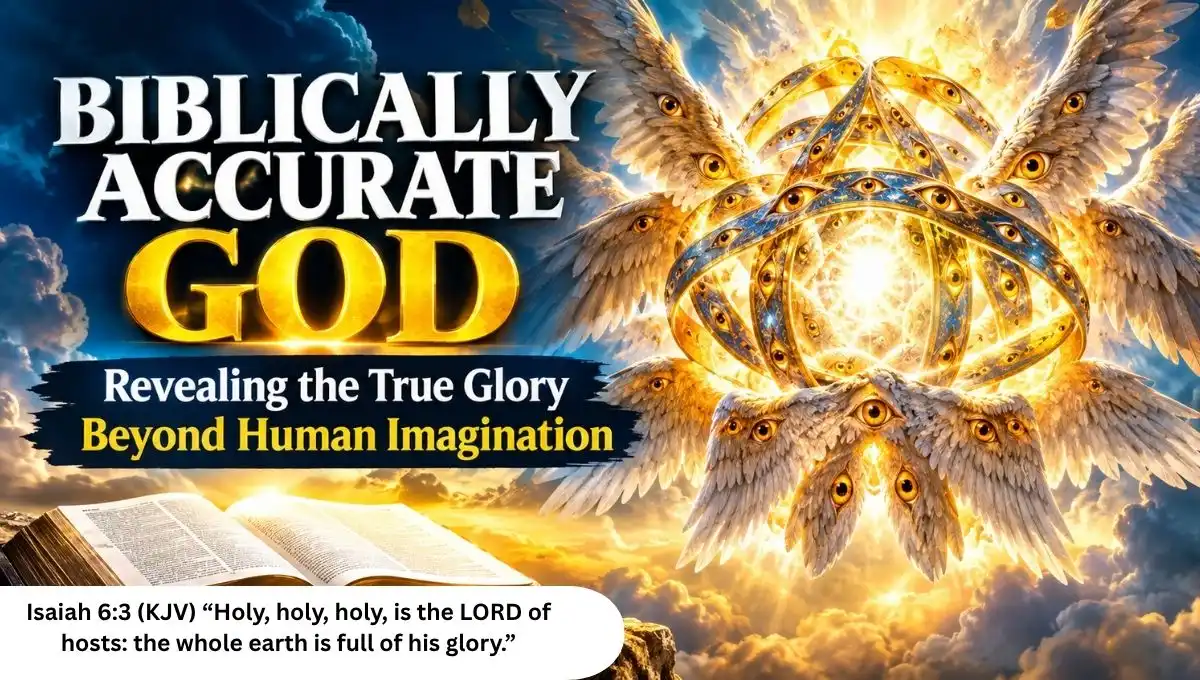
What does the Bible actually say about what God looks like? Many people picture God through Renaissance paintings, traditional artwork, or cultural ideas rather than Scripture. The biblically accurate God is far more majestic, mysterious, and beyond human understanding than any painting can fully portray.
Throughout the Bible, God reveals Himself through powerful visions, blazing fire, radiant glory, living creatures, and even a still, small voice. These biblical descriptions show that God cannot be reduced to a simple human image or physical form.
Instead, Scripture reveals His holiness, power, eternal nature, and divine presence in remarkable ways. This guide explores what the Bible says about God’s appearance, character, manifestations, and glory, helping you understand the biblically accurate God through Scripture.
The Concept of a Biblically Accurate God
The term “Biblically accurate God” simply means describing God the way Hebrew Scriptures and Christian Scriptures actually describe Him, instead of relying on artistic representations from paintings and movies.
The Bible calls God a spirit (John 4:24). He is not a physical man in the sky. He is a transcendent being who exists outside of time and is not limited by a human body.
Because God is invisible by nature, every biblical description of God’s appearance is really a description of His glory, not His literal body. This is the starting point for any honest look at the biblical God.
Core Divine Attributes Revealed in Scripture
Scripture reveals God’s nature through a consistent set of divine attributes. These attributes are unchanging and separate God completely from created beings.
Essential Divine Attributes
| Attribute | Meaning | Example Verse |
| Omnipotence | God’s unlimited power | Jeremiah 32:17 |
| Omniscience | God is all-knowing | Psalm 147:5 |
| Omnipresence | God is everywhere | Psalm 139:7-10 |
| Immutability | God does not change | Malachi 3:6 |
| Eternal Nature | God exists outside of time | Psalm 90:2 |
| Holiness | Complete separateness and moral perfection | Isaiah 6:3 |
These divine attributes are not separate “parts” of God. They describe the one, unified divine nature of a single eternal God.
God’s Various Forms and Manifestations
The Bible describes several forms of divine manifestation, moments when God made His presence known in a way people could perceive.
● A burning bush that was not consumed (Exodus 3)
● A pillar of cloud and fire guiding Israel (Exodus 13:21-22)
● The Shekinah glory filling the temple (1 Kings 8:10-11)
● A still small voice heard by Elijah (1 Kingdoms 19:12)
● Christophany appearances of Christ before His birth in Bethlehem
Key Distinctions in Divine Manifestation
A theophany is any visible appearance of God in the Old Testament. A Christophany is specifically a pre-incarnate appearance of Christ. Both are real but temporary; neither shows God’s full, unveiled glory, because no human could survive seeing that directly (Exodus 33:20).
Read Also: 296+ Best Bible Verse Wallpaper Black Dark Aesthetic Scripture Backgrounds for Phone & Desktop
Biblical Descriptions of God’s Appearance
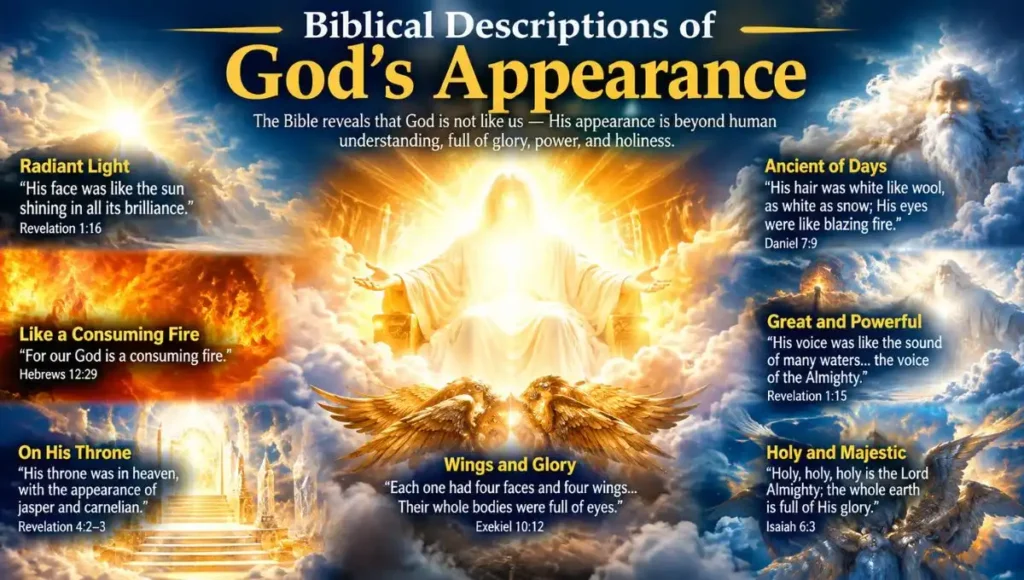
When Scripture does describe God’s appearance, the language is symbolic and overwhelming, never simple or human-like.
Prophetic Visions of Divine Glory
The Ezekiel vision describes wheels of fire, four living creatures with four faces, and a throne of sapphire above them, with a figure like glowing bronze seated on it (Ezekiel 1). The Isaiah vision of God shows a high and exalted throne, with seraphim covering their faces and calling “Holy, Holy, Holy” (Isaiah 6).
The Revelation vision of Christ describes blazing eyes, feet like glowing bronze, and a voice like rushing waters, with a two-edged sword from His mouth (Revelation 1:14-16). This is the glorified Christ, not an ordinary human figure.
Progressive Revelation of God’s Character
God’s character unfolds gradually across Scripture through progressive revelation:
● Creation account – God as Creator and sustainer of all things
● Patriarchal era – God as a personal, covenant-keeping guide
● Mosaic Law – God as holy lawgiver and judge
● Prophetic writings – God as both just and merciful
● New Testament – God fully revealed in Jesus Christ
Each stage adds detail. None of them contradicts the others.
God’s Holiness, Power, and Majesty in Scripture
God’s holiness means complete separateness from sin and created beings. His power is unlimited, and His majesty is described using imagery of fire, light, and thunder because human language cannot fully hold divine holiness.
The Ancient of Days in Daniel 7:9 is described with clothing blazing white and hair like pure wool, seated on a throne of fiery flames. This image points to God’s eternal nature and complete authority over creation and the heavenly court.
Biblical Symbols That Help Describe God’s Glory
Scripture repeatedly uses physical symbols to communicate God’s glory, since human description always falls short of the real thing.
| Symbol | What It Represents |
| Fire | Purity, judgment, holy presence |
| Cloud (glory cloud) | God’s dwelling presence among His people |
| Light | God’s moral perfection and truth |
| Throne | God’s sovereign rule over the heavenly throne |
| Wind or breath | God’s unseen, active power |
These symbols are not literal descriptions. They are theological pictures meant to point beyond themselves toward the invisible God.
Experiencing the Presence of God in Everyday Life
Most believers do not receive prophetic visions. Instead, the presence of God is experienced through ordinary means: prayer, Scripture, and the Christian community.
● Prayer opens an ongoing relationship with God, not a one-time event.
● Scripture reveals God’s character consistently, without guesswork.
● The Christian community reflects God’s presence when believers gather together.
● God’s guiding presence is often felt most clearly during suffering, when the brokenhearted sense He is near (Psalm 34:18).
Read Also: 40+ Beautiful Bible Verse About Flowers and Faith
Jesus Christ: The Complete Revelation of God
The clearest answer to what God is really like is Jesus Christ. He is not a separate, lesser picture of God; He is God’s complete and final self-revelation.
Christ as the Perfect Image of God
Colossians 1:15 calls Jesus “the image of the invisible God.” This means Jesus Christ shows, in human form, exactly who God is without distortion or error.
Jesus as God’s Exact Representation
Hebrews 1:3 describes Jesus as “the exact representation” of God’s being, radiating God’s glory. This is a direct, unambiguous claim that Jesus as God is not myth or metaphor but biblical revelation.
Divine Attributes Displayed Through Jesus
Jesus displayed the divine attributes of Jesus openly during His earthly life:
● Authority over creation, shown by calming storms and healing the sick
● Compassion of Jesus, shown toward the sick, the outcast, and the brokenhearted
● Holiness of Christ, shown through a sinless life
● Justice of Jesus, shown in His teaching and His confrontation of religious hypocrisy
Jesus as the Key to Understanding Scripture
Reading the Bible through a Christ-centered Scripture lens (proper exegesis, not eisegesis) keeps interpretation grounded. Jesus Himself said that Scripture testifies about Him (John 5:39), tying the entire biblical revelation of God together in one person.
Essential Characteristics of the Biblically Accurate God
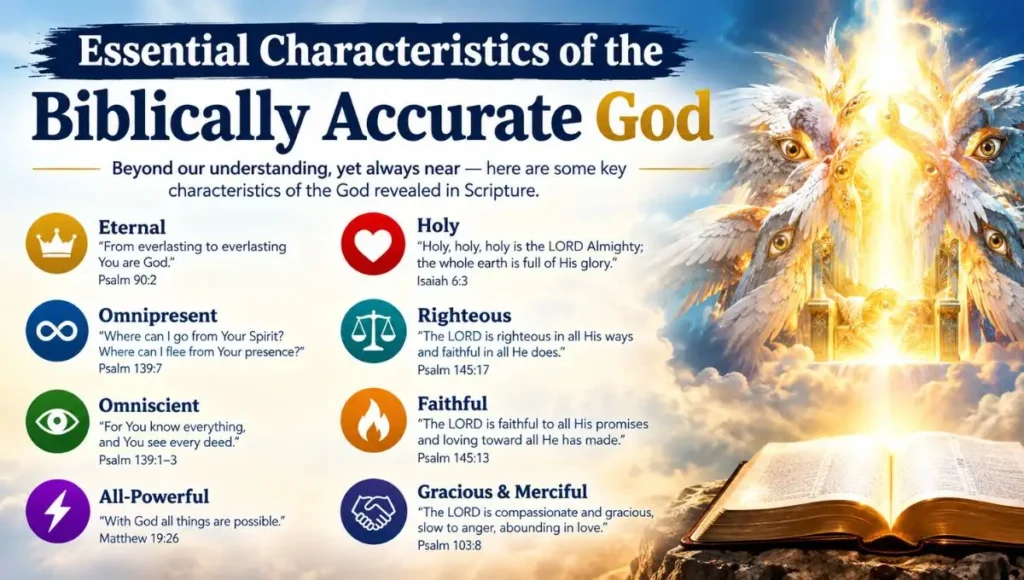
Bringing these threads together, a short summary helps clarify what people usually search for when studying the Biblically accurate God.
Bible Accurate God
A Bible accurate God is spirit, not flesh, described through fire, light, cloud, and throne imagery rather than a simple human form.
Biblical Accurate God
A Biblical accurate God is holy, all-powerful, all-knowing, and present everywhere at once, unlike any created being.
God Biblically Accurate
Understanding God biblically accurate means reading Ezekiel, Isaiah, Daniel, and Revelation together, since each vision adds a piece of the larger picture.
Biblically Accurate God Appearance
A Biblically accurate God appearance is never plain or human-like. It involves wheels of fire, blazing eyes, glowing bronze, and radiant, overwhelming glory cloud imagery.
Read Also: Coldest Bible Verses: The Most Powerful and Striking Scriptures in the Bible
Why Human Images Cannot Fully Capture God
Human understanding is limited, and human imagination cannot represent an infinite, spiritual being using paint, marble, or film. Every artistic representation is, at best, a theological guess shaped by cultural assumptions rather than direct sight.
Even the prophets who received visions described God using comparisons and symbols, not exact physical detail, because the unveiled glory of God is too much for created beings to fully process. This is why the Biblically accurate God will always be more transcendent and personal than any single image can show, yet fully knowable through Christ.
Frequently Asked Questions
What does Biblically accurate God the Father look like?
Scripture never gives God the Father a fixed physical form; He is spirit, described only through symbols like fire, light, and a heavenly throne.
What is a Biblically accurate angel according to the Bible?
Biblical angels are often described with multiple wings, faces, and fiery appearances (Ezekiel 1, Isaiah 6), very different from soft, human-winged art.
What does Biblically accurate heaven look like?
Revelation describes heaven with a jasper-like throne, rainbow light, and four living creatures surrounding God’s throne in constant worship.
What does Biblically accurate Jesus look like?
On earth Jesus looked like an ordinary man, but Revelation 1 describes the glorified Christ with blazing eyes and feet like glowing bronze.
What is a Biblically accurate demon?
Scripture gives few physical details about demons; they are described as fallen spiritual beings, not the cartoonish red figures of popular art.
What does a Biblically accurate seraphim look like?
Isaiah 6 describes seraphim as fiery beings with six wings, covering their faces and feet while calling out “Holy, Holy, Holy.”
What does God look like according to the Bible?
The Bible describes God’s presence through fire, cloud, light, and throne imagery rather than a literal human face or body.
How is Biblically accurate God different from traditional artwork?
Traditional artwork shows a human-like elder figure, while Scripture shows an invisible, spiritual being revealed through symbolic, overwhelming glory.
Conclusion
A Biblically accurate God is holy, eternal, all-powerful, and present everywhere, described through fire, cloud, throne, and light rather than simple human form. Yet Scripture does not leave God distant or abstract; through Jesus Christ, the exact representation of the invisible God, this transcendent being becomes personal and knowable. Studying God’s true nature in Scripture, not popular art, leads to a deeper, more accurate relationship with the real, biblical God.

Abdul Mannan Haider is a content writer at [InspiredMsg.com], specializing in Messages and Prayers. With 5 years of experience, he creates meaningful, engaging, and easy-to-read content that connects with readers.