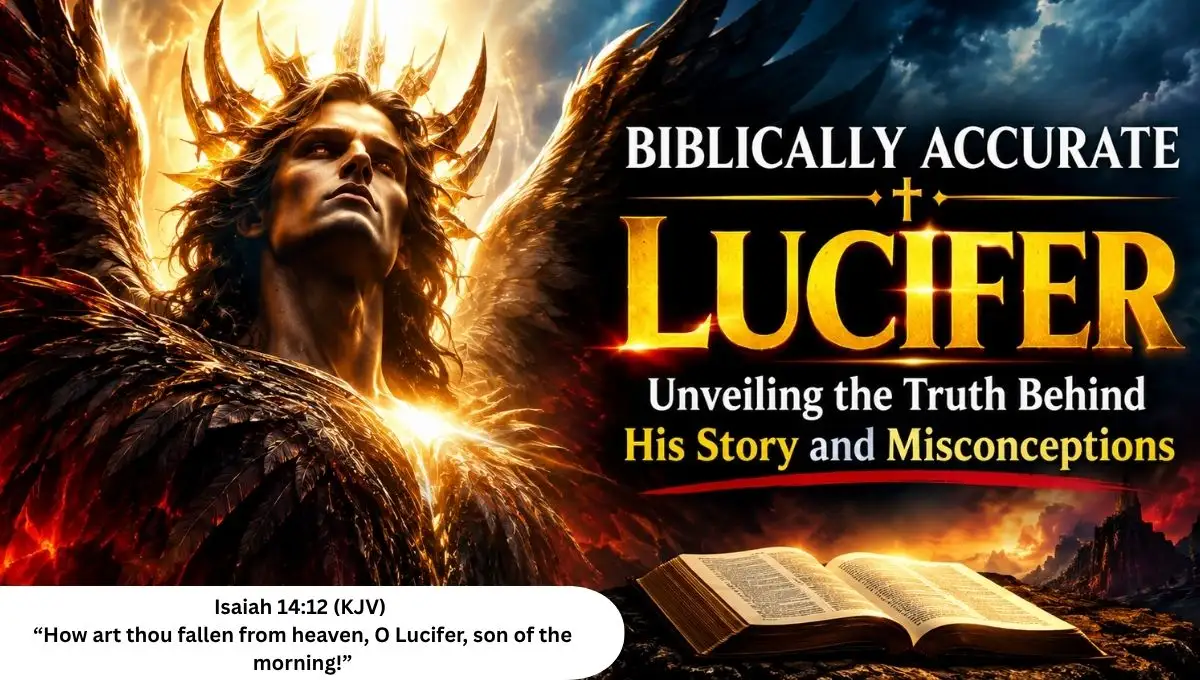
The figure known as Lucifer has fascinated theologians and readers for centuries, yet much of what people believe comes from art and legend rather than the biblical text itself. Understanding the biblically accurate Lucifer means going back to the original Hebrew Scripture, not later medieval imagination.
It means separating the “morning star” imagery in Isaiah from centuries of embellishment, and recognizing that horns, red skin, and a pitchfork appear nowhere in the biblical record.
At its core, this is a story about pride corrupting a being of great beauty and wisdom into open rebellion against God. A clear, biblically accurate Lucifer emerges only when Scripture, not tradition, sets the terms of the discussion.
Biblically Accurate Understanding of Lucifer’s Identity
The name “Lucifer” appears only once in the King James Bible, in Isaiah 14:12. It comes from a Latin word meaning “light-bringer,” not from an original Hebrew name.
Understanding a Biblically Accurate Lucifer starts with recognizing that most of his popular identity was built over centuries, layered on top of a handful of ambiguous verses.
Common Misconceptions About Lucifer in Modern Culture
Movies, games, and even sermons often blend unrelated verses into a single “Lucifer story” that Scripture never actually tells that way.
Popular Misunderstandings:
- Lucifer and Satan are treated as identical from Genesis onward.
- He is imagined as an angel with bat wings and horns.
- Isaiah 14 is read as literal angelology rather than poetic taunt against a king.
- He is assumed to rule Hell as a throne-sitting king.
What Scripture Actually Reveals About Lucifer
The Bible never uses the word “Lucifer” as a proper name for a fallen angel in the original languages. It is a Latin translation choice, applied later to a poetic passage about a Babylonian king’s downfall.
The Hebrew Original: Helel and Its True Meaning
The Hebrew word behind “Lucifer” is helel (הֵילֵל), found in Isaiah 14:12. It literally means “shining one” or “morning star,” referring to the planet Venus.
Helel: Linguistic Analysis
| Term | Language | Literal Meaning | Common Reference |
| Helel | Hebrew | Shining one, morning star | Venus |
| Heylel ben Shachar | Hebrew | Son of the dawn | Poetic title |
| Lucifer | Latin | Light-bringer | Jerome’s translation |
| Morning Star | English | Venus at dawn | KJV rendering |
Jerome’s Latin Vulgate and the Birth of ‘Lucifer’
In the 4th century, Jerome translated helel into Latin as “lucifer,” a common astronomical term for the morning star, not a proper name for a devil.
King James Translation and English Christian Tradition
The 1611 King James translators kept Jerome’s Latin word “Lucifer” directly in Isaiah 14:12, which cemented it as a proper name in English-speaking Christianity.
Translation Comparison Across Versions
| Bible Version | Isaiah 14:12 Rendering |
| KJV | “Lucifer, son of the morning” |
| NIV | “Morning star, son of the dawn” |
| ESV | “Day Star, son of Dawn” |
| NASB | “Star of the morning, son of the dawn” |
Biblically Accurate Description of Lucifer’s Appearance
Scripture gives no direct physical description of a being named “Lucifer.” What it does offer is a poetic description of a covering cherub in Ezekiel 28 and a star-like title in Isaiah 14.
Lucifer’s Pre-Fall Glory According to Ezekiel
Ezekiel 28:12-15 describes a being of great beauty and wisdom, “the seal of perfection,” covered in precious stones, before pride led to his downfall.
Ezekiel’s Description of Original Splendor
- Adorned with nine precious stones
- Anointed as a guardian cherub
- Present on “the holy mountain of God”
- Described as blameless “till iniquity was found” in him
The Morning Star Imagery in Isaiah’s Prophecy
Isaiah 14:12 uses “morning star” imagery to describe a proud ruler who claimed heavenly status and was cast down to the depths.
Morning Star Symbolism:
- Represents brightness and exalted position
- Tied to Venus, visible just before sunrise
- Symbolizes pride that leads to a dramatic fall
- Later applied typologically to a rebellious spiritual power
Does Lucifer Possess Physical Form After His Fall
The Bible does not describe a fixed physical form for Satan after his fall. References describe deceptive appearances rather than one fixed body.
Post-Fall Manifestation Possibilities
- Appears “as an angel of light” (2 Corinthians 11:14)
- Symbolized as a serpent in Genesis 3
- Depicted as a dragon in Revelation 12
- No consistent physical description across texts
What Biblical Silence Tells Us Lucifer Is Not
Scripture never mentions horns, a pitchfork, red skin, or a throne in a fiery underworld kingdom for this figure.
Unbiblical Attributes:
- Horns and cloven hooves
- Pitchfork or trident
- Red or crimson skin
- Ruling a throne room in Hell
Lucifer in the Bible vs. Popular Christian Tradition
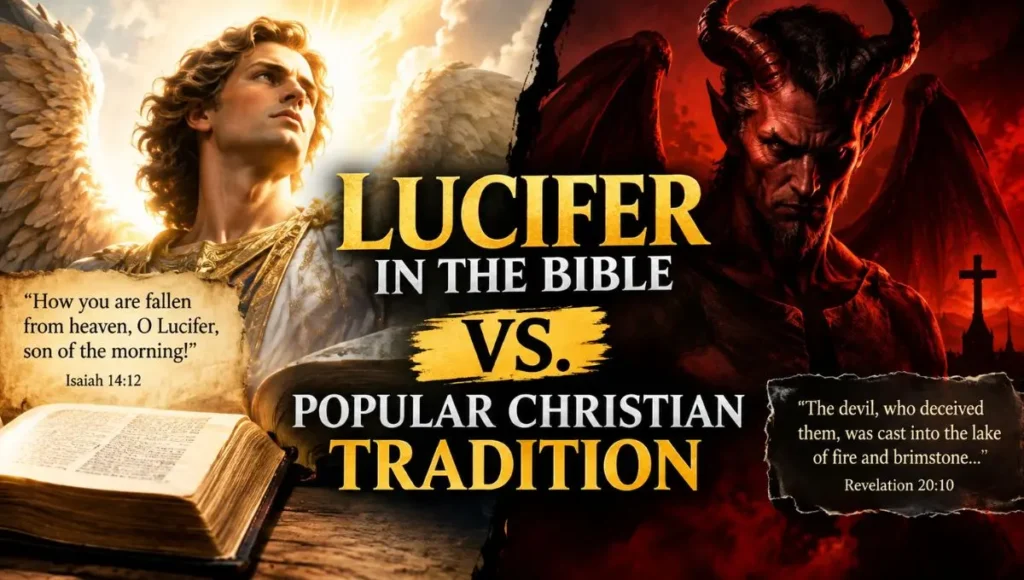
Tradition combined several separate passages into a single narrative that the biblical text itself never fully connects in one place.
Biblical References Commonly Linked to Lucifer
Isaiah 14, Ezekiel 28, Luke 10:18, and Revelation 12 are the passages most often cited, though each has a different immediate context.
How Tradition Shaped Lucifer’s Identity
Early church writers, including Origen and Tertullian, began reading Isaiah 14 as referring to Satan’s origin, not just a Babylonian king.
Scripture vs. Later Interpretations
| Element | Scripture’s Focus | Later Tradition’s Addition |
| Isaiah 14 | Fall of a Babylonian king | Fall of Satan from heaven |
| Ezekiel 28 | Fall of the king of Tyre | Fall of a cherub-angel |
| “Lucifer” | Latin word for morning star | Proper name for the devil |
Read Also: 30 Most Powerful Prayers to Pray at Midnight
Critical Distinction Between Lucifer and Satan in Scripture
Many scholars argue that treating “Lucifer” and “Satan” as interchangeable names overreads a single poetic title into a settled doctrine.
Biblical Evidence Supporting Their Distinction
The word “Lucifer” never appears in the New Testament, while “Satan” appears dozens of times as an active adversary figure.
Comparative Analysis of Names and Roles
| Aspect | Lucifer | Satan |
| Appearances in Bible | 1 (KJV, Isaiah 14:12) | 50+ times across both testaments |
| Language origin | Latin translation | Hebrew “adversary” |
| Context | Poetic taunt-song | Active accuser/tempter |
| Testament | Old Testament only | Old and New Testament |
How Christian Tradition Merged These Figures
Over centuries, sermons, art, and literature fused the “morning star” imagery with the New Testament adversary into one composite character.
Historical Development:
- 3rd century: Origen links Isaiah 14 to Satan’s fall
- 4th century: Jerome’s Vulgate popularizes “Lucifer”
- Medieval era: Church art solidifies the merged figure
- Renaissance: Milton’s Paradise Lost dramatizes the union
Protestant Reformers’ Rejection of the Equation
Some Reformation-era theologians questioned reading Isaiah 14 as literal angelology, emphasizing its original context as judgment on a human king.
Why This Theological Distinction Matters Today
Confusing poetic titles with doctrine can lead to misreading Scripture and building beliefs on assumptions rather than clear text.
Practical Implications:
- Encourages careful, context-based Bible reading
- Prevents over-literal interpretation of poetic language
- Clarifies what is confirmed doctrine versus tradition
- Supports healthier theological discussion
Biblically Accurate Account of Lucifer’s Fall and Significance
The fall narrative, as popularly told, combines pride, rebellion, and expulsion from heaven, though the full sequence is pieced together from separate texts.
The Narrative of the Fallen Angel in Scripture
Luke 10:18 records Jesus saying, “I saw Satan fall like lightning from heaven,” a brief but significant statement about a heavenly defeat.
Chronological Progression of Lucifer’s Story
- Created as a glorious, wise being (Ezekiel 28)
- Pride enters his heart (Ezekiel 28:17)
- Ambition to be “like the Most High” (Isaiah 14:14)
- Cast down from heaven (Luke 10:18, Revelation 12:9)
Lucifer’s Five ‘I Will’ Declarations of Pride
Isaiah 14:13-14 lists five statements beginning with “I will,” showing escalating ambition to seize God’s authority.
Progressive Escalation of Rebellion:
- “I will ascend into heaven”
- “I will exalt my throne above the stars of God”
- “I will sit also upon the mount of the congregation”
- “I will ascend above the heights of the clouds”
- “I will be like the most High”
The Nature of Sin: Pride in God-Given Perfection
Ezekiel 28:17 states plainly that pride corrupted him because of his own beauty and wisdom, not because of any external force.
Catastrophic Consequences of Angelic Rebellion
The rebellion resulted in expulsion from a position of honor to one of shame, described as being “cast to the ground” and “brought to the pit.”
Reversal from Glory to Degradation
| Before | After |
| Guardian cherub | Cast out of the mountain of God |
| Covered in precious stones | Brought to ashes and dust |
| Blameless in his ways | Filled with violence and sin |
The Scope of Rebellion: One-Third of Angels
Revelation 12:4 describes a dragon whose tail “drew the third part of the stars of heaven,” widely interpreted as one-third of the angels joining the rebellion.
Biblical Verses Commonly Associated With Lucifer
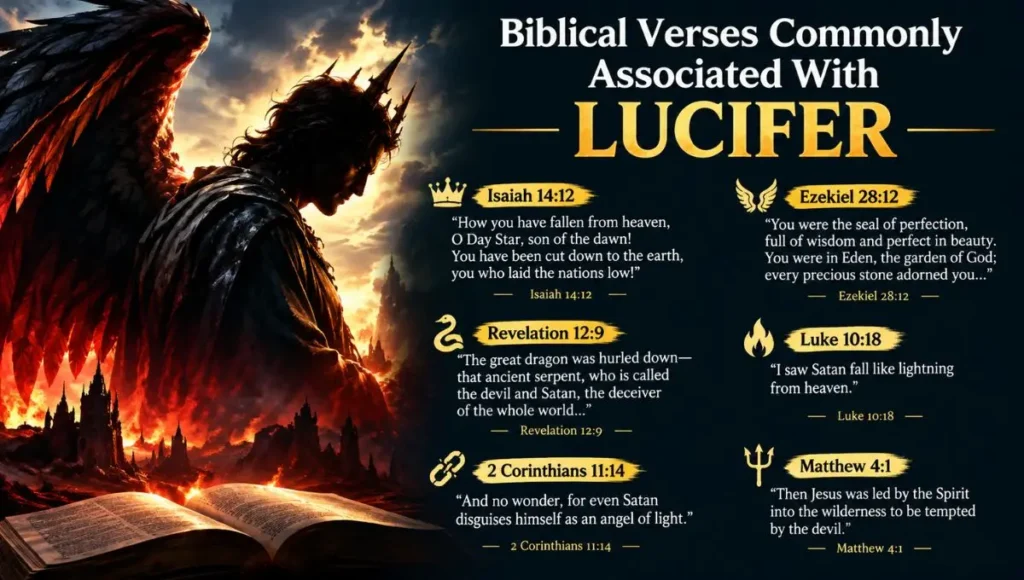
Isaiah 14 and the Morning Star
This chapter is a taunt song against the king of Babylon, using “morning star” imagery to describe his humiliating fall from power.
Ezekiel 28 and the Fallen Ruler
This chapter addresses the king of Tyre but includes language many read as pointing beyond a human ruler to a deeper spiritual fall.
Revelation and Satan’s Defeat
Revelation 12 and 20 describe the dragon’s final defeat and eternal judgment, closing the biblical narrative arc of rebellion and consequence.
Read Also: 9 Most Powerful Prayers for Successful Cancer Surgery
Artistic Evolution of Lucifer’s Image Throughout History
Artistic depictions changed dramatically across eras, shaped more by culture than by Scripture itself.
Early Medieval Period: The Ethereal Blue Angel
Early Christian art often portrayed Satan as a beautiful, pale-blue angel, emphasizing his former glory rather than monstrous evil.
Characteristics of Early Depictions:
- Human-like, angelic features
- Blue or pale skin tones
- Wings similar to other angels
- Minimal grotesque imagery
High Medieval Transformation to Grotesque Forms
By the 11th-13th centuries, artists began adding horns, claws, and animalistic features to visually separate Satan from holy angels.
Evolution of Medieval Imagery
- Introduction of goat-like horns
- Addition of bat-like wings
- Dark or black skin tones
- Grotesque, monstrous facial features
Renaissance Romanticization: Milton’s Tragic Rebel
John Milton’s Paradise Lost (1667) reimagined Satan as a tragic, articulate anti-hero, deeply influencing how later generations pictured him.
Victorian Era Through Modern: The Theatrical Red Devil
The now-familiar red-skinned devil with a pitchfork became popular through 19th-century theater, cartoons, and folklore, not Scripture.
Modern Representations Across Media
- Comic books and animation
- Video games and horror films
- Halloween costumes and pop culture branding
- TV adaptations emphasizing charisma over horror
Contrasts Between Artistic and Biblical Portrayals
Key Divergences:
- Scripture never assigns red skin or horns
- Art often gives a single fixed body; Scripture implies shifting deception
- Tradition emphasizes physical monstrosity; Scripture emphasizes pride and fall
- Popular culture softens or humorizes a figure Scripture treats seriously
Lucifer’s Role in Christian Theology and Spiritual Warfare
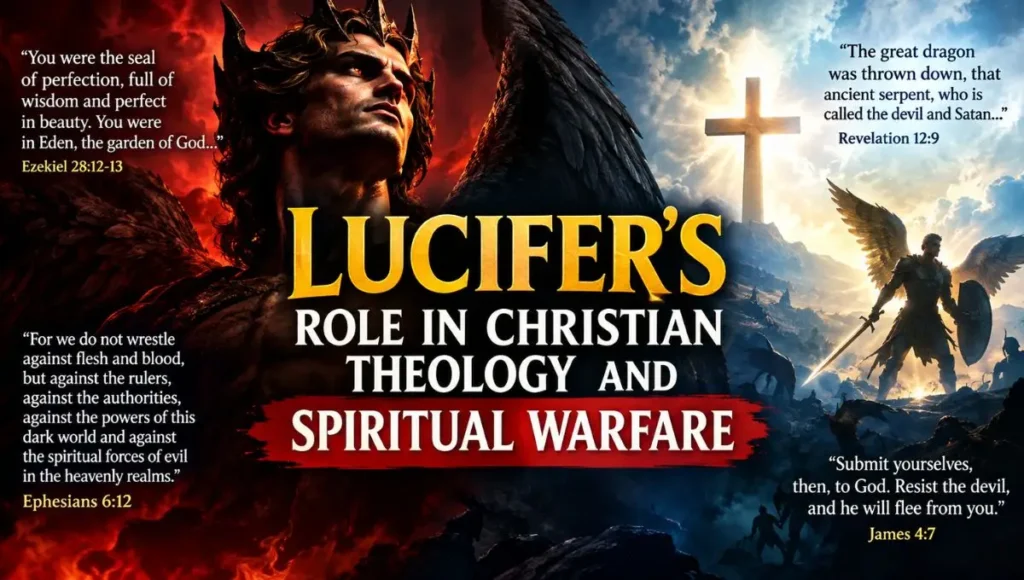
Lucifer’s Relationship to Satan in Christian Thought
Mainstream Christian tradition treats “Lucifer” as a poetic title later applied to Satan, even though the biblical text itself doesn’t explicitly equate them.
The Role of Temptation and Deception
Satan is consistently described as a tempter and deceiver, from the serpent in Eden to “the deceiver of the whole world” in Revelation 12:9.
The Final Judgment of Satan and Evil
Revelation 20:10 describes Satan being “cast into the lake of fire and brimstone,” ending the rebellion with permanent judgment.
Read Also: Coldest Bible Verses: The Most Powerful and Striking Scriptures in the Bible
Theological Insights from a Biblically Accurate Lucifer
The Paradox of Created Perfection and Free Will
A being described as perfect and blameless still chose rebellion, raising enduring theological questions about free will and the origin of sin.
Theological Tensions:
- How evil arises in a perfect creation
- The role of free will in angelic beings
- God’s foreknowledge versus genuine choice
- The justice of eternal consequences for finite rebellion
The Origin of Evil Within a Perfect Being
Ezekiel 28:15 states iniquity was “found” in him, suggesting evil originated internally through choice, not through external corruption.
Pride’s Specific Temptation: Giftedness and Position
His fall is tied directly to his own beauty, wisdom, and high position, not weakness or ignorance.
Pride’s Manifestations in Lucifer
- Self-admiration over God-given gifts
- Desire for worship rather than service
- Ambition to replace rather than reflect God’s authority
- Refusal to remain in an assigned position
Cosmic Implications: Corrupting Others and Spiritual Warfare
His rebellion did not stay isolated; Revelation suggests he drew other angels into the same fall, extending conflict into ongoing spiritual warfare.
Broader Consequences:
- Introduction of temptation into human history
- Ongoing spiritual conflict described throughout the New Testament
- A model for how pride can spread influence
- A backdrop for the biblical theme of redemption
Lessons for Humanity: Humility and Dependence on God
The narrative is often read as a warning: giftedness and status without humility can lead to the same destructive pride.
Practical Applications from Lucifer’s Fall
- Value humility over self-exaltation
- Recognize gifts as given, not self-made
- Stay accountable within community rather than isolated ambition
- Treat pride as a warning sign, not a strength
Frequently Asked Questions
What does Biblically accurate Lucifer look like?
Scripture gives no fixed physical description; it only mentions former beauty, precious stones, and morning-star imagery.
What happened during the fall of Lucifer in the Bible?
Pride led to rebellion against God, resulting in expulsion from heaven, as referenced in Ezekiel 28 and Luke 10:18.
What is the description of Lucifer in the Bible KJV?
The KJV mentions “Lucifer, son of the morning” only once, in Isaiah 14:12, describing a fallen, once-glorious figure.
Who is Lucifer in the Bible?
“Lucifer” is a Latin translation of a Hebrew title meaning “morning star,” traditionally applied to describe Satan’s fall from heaven.
Was Lucifer a seraphim?
Ezekiel 28:14 calls him an “anointed cherub,” not a seraph, though popular tradition sometimes blends angelic categories.
Is Lucifer evil according to the Bible?
Yes; once pride and rebellion entered him, Scripture consistently portrays him as an adversary and deceiver of humanity.
How is Biblically accurate Lucifer different from traditional artwork?
The Bible never mentions horns, red skin, or a pitchfork; those images developed through medieval and later artistic tradition.
What is the connection between Biblically accurate Lucifer and Jesus?
Jesus is called “the bright morning star” in Revelation 22:16, a title contrast that highlights His purity against Lucifer’s fallen pride.
Conclusion
A Biblically Accurate Lucifer looks far different from popular imagination. Scripture presents a poetic title, a fallen cherub, and a warning about pride, not a horned, red-skinned character.
Reading the original texts carefully separates centuries of artistic tradition from what the Bible actually teaches, offering a clearer, more grounded understanding of this often-misunderstood figure.

Abdul Mannan Haider is a content writer at [InspiredMsg.com], specializing in Messages and Prayers. With 5 years of experience, he creates meaningful, engaging, and easy-to-read content that connects with readers.