Repentance is one of the most powerful and life-changing themes woven throughout the entire Bible. From Genesis to Revelation, God calls His people to turn away from sin and return to Him with a whole heart.
Whether you are searching for Bible verses about repentance to strengthen your faith, prepare a sermon, or find personal healing, Scripture provides everything you need.
The word “repentance” in the Bible is not simply feeling sorry. It is a complete turning a change of mind, heart, and direction.
The Greek word metanoia literally means “a change of mind,” while the Hebrew word shub means “to return.” Together, they paint a full picture of what God expects when He calls us to repent.
In this article, you will find over 244 references and 54 core Bible verses about repentance from the KJV and major translations, organized by theme to help you understand repentance and forgiveness, repentance and salvation, and how true repentance leads to spiritual renewal.
54 Bible Verses About Repentance (KJV)
These 54 Bible verses about repentance are drawn from both the Old and New Testaments of the King James Version. They form the biblical foundation of what it means to turn from sin and walk with God.
- Acts 3:19 – “Repent ye therefore, and be converted, that your sins may be blotted out, when the times of refreshing shall come from the presence of the Lord.”
- Matthew 4:17 – “From that time Jesus began to preach, and to say, Repent: for the kingdom of heaven is at hand.”
- 2 Peter 3:9 – “The Lord is not slack concerning his promise, as some men count slackness; but is longsuffering to us-ward, not willing that any should perish, but that all should come to repentance.”
- Acts 2:38 – “Then Peter said unto them, Repent, and be baptized every one of you in the name of Jesus Christ for the remission of sins, and ye shall receive the gift of the Holy Ghost.”
- Luke 13:3 – “I tell you, Nay: but, except ye repent, ye shall all likewise perish.”
- 1 John 1:9 – “If we confess our sins, he is faithful and just to forgive us our sins, and to cleanse us from all unrighteousness.”
- 2 Chronicles 7:14 – “If my people, which are called by my name, shall humble themselves, and pray, and seek my face, and turn from their wicked ways; then will I hear from heaven, and will forgive their sin, and will heal their land.”
- Revelation 3:19 – “As many as I love, I rebuke and chasten: be zealous therefore, and repent.”
- Isaiah 55:7 – “Let the wicked forsake his way, and the unrighteous man his thoughts: and let him return unto the Lord, and he will have mercy upon him; and to our God, for he will abundantly pardon.”
- Joel 2:12–13 – “Therefore also now, saith the Lord, turn ye even to me with all your heart, and with fasting, and with weeping, and with mourning: And rend your heart, and not your garments, and turn unto the Lord your God: for he is gracious and merciful, slow to anger, and of great kindness.”
- Ezekiel 18:30 – “Repent, and turn yourselves from all your transgressions; so iniquity shall not be your ruin.”
- Proverbs 28:13 – “He that covereth his sins shall not prosper: but whoso confesseth and forsaketh them shall have mercy.”
- Acts 17:30 – “And the times of this ignorance God winked at; but now commandeth all men every where to repent.”
- Luke 5:32 – “I came not to call the righteous, but sinners to repentance.”
- Jeremiah 3:22 – “Return, ye backsliding children, and I will heal your backslidings.”
- Ezekiel 33:11 – “Say unto them, As I live, saith the Lord God, I have no pleasure in the death of the wicked; but that the wicked turn from his way and live: turn ye, turn ye from your evil ways.”
- Matthew 3:8 – “Bring forth therefore fruits meet for repentance.”
- Mark 1:15 – “The time is fulfilled, and the kingdom of God is at hand: repent ye, and believe the gospel.”
- Psalm 51:10 – “Create in me a clean heart, O God; and renew a right spirit within me.”
- Isaiah 1:18 – “Come now, and let us reason together, saith the Lord: though your sins be as scarlet, they shall be as white as snow.”
- Hosea 14:1 – “O Israel, return unto the Lord thy God; for thou hast fallen by thine iniquity.”
- Jeremiah 31:19 – “Surely after that I was turned, I repented; and after that I was instructed, I smote upon my thigh: I was ashamed, yea, even confounded.”
- James 4:8 – “Draw nigh to God, and he will draw nigh to you. Cleanse your hands, ye sinners; and purify your hearts, ye double minded.”
- Zechariah 1:3 – “Turn ye unto me, saith the Lord of hosts, and I will turn unto you.”
- Lamentations 3:40 – “Let us search and try our ways, and turn again to the Lord.”
- 2 Corinthians 7:10 – “For godly sorrow worketh repentance to salvation not to be repented of: but the sorrow of the world worketh death.”
- Psalm 34:18 – “The Lord is nigh unto them that are of a broken heart; and saveth such as be of a contrite spirit.”
- Isaiah 30:15 – “In returning and rest shall ye be saved; in quietness and in confidence shall be your strength.”
- Luke 15:7 – “I say unto you, that likewise joy shall be in heaven over one sinner that repenteth.”
- Luke 15:10 – “Likewise, I say unto you, there is joy in the presence of the angels of God over one sinner that repenteth.”
- Malachi 3:7 – “Return unto me, and I will return unto you, saith the Lord of hosts.”
- Psalm 51:17 – “The sacrifices of God are a broken spirit: a broken and a contrite heart, O God, thou wilt not despise.”
- Ezekiel 18:21 – “But if the wicked will turn from all his sins that he hath committed, and keep all my statutes, and do that which is lawful and right, he shall surely live, he shall not die.”
- Acts 26:20 – “But shewed first unto them of Damascus, and at Jerusalem…that they should repent and turn to God, and do works meet for repentance.”
- Revelation 2:5 – “Remember therefore from whence thou art fallen, and repent, and do the first works.”
- Isaiah 44:22 – “I have blotted out, as a thick cloud, thy transgressions, and, as a cloud, thy sins: return unto me; for I have redeemed thee.”
- Jeremiah 18:8 – “If that nation, against whom I have pronounced, turn from their evil, I will repent of the evil that I thought to do unto them.”
- Jonah 3:10 – “And God saw their works, that they turned from their evil way; and God repented of the evil, that he had said that he would do unto them; and he did it not.”
- Numbers 23:19 – “God is not a man, that he should lie; neither the son of man, that he should repent.”
- Exodus 13:17 – “God led them not through the way of the land of the Philistines…lest peradventure the people repent when they see war, and they return to Egypt.”
- Matthew 11:21 – “Woe unto thee, Chorazin! woe unto thee, Bethsaida! for if the mighty works, which were done in you, had been done in Tyre and Sidon, they would have repented long ago.”
- Luke 24:47 – “And that repentance and remission of sins should be preached in his name among all nations, beginning at Jerusalem.”
- 1 Kings 8:47 – “Yet if they shall bethink themselves in the land whither they were carried captives, and repent, and make supplication unto thee in the land of them that carried them captives.”
- Nehemiah 1:9 – “But if ye turn unto me, and keep my commandments, and do them; though there were of you cast out unto the uttermost part of the heaven, yet will I gather them from thence.”
- Psalm 32:5 – “I acknowledged my sin unto thee, and mine iniquity have I not hid. I said, I will confess my transgressions unto the Lord; and thou forgavest the iniquity of my sin.”
- Acts 8:22 – “Repent therefore of this thy wickedness, and pray God, if perhaps the thought of thine heart may be forgiven thee.”
- Hebrews 6:1 – “Therefore leaving the principles of the doctrine of Christ, let us go on unto perfection; not laying again the foundation of repentance from dead works.”
- Hebrews 12:17 – “For ye know how that afterward, when he would have inherited the blessing, he was rejected: for he found no place of repentance, though he sought it carefully with tears.”
- Matthew 12:41 – “The men of Nineveh shall rise in judgment with this generation, and shall condemn it: because they repented at the preaching of Jonas.”
- Luke 17:3 – “If thy brother trespass against thee, rebuke him; and if he repent, forgive him.”
- Luke 17:4 – “And if he trespass against thee seven times in a day, and seven times in a day turn again to thee, saying, I repent; thou shalt forgive him.”
- 2 Timothy 2:25 – “In meekness instructing those that oppose themselves; if God peradventure will give them repentance to the acknowledging of the truth.”
- Jeremiah 26:3 – “If so be they will hearken, and turn every man from his evil way, that I may repent me of the evil, which I purpose to do unto them.”
- Ezekiel 14:6 – “Repent, and turn yourselves from your idols; and turn away your faces from all your abominations.”
Scriptures on True Repentance
Not all sorrow over sin is biblical repentance. The Scriptures on true repentance draw a sharp line between worldly sorrow and godly sorrow.
Paul describes this distinction clearly: “For godly sorrow worketh repentance to salvation not to be repented of: but the sorrow of the world worketh death” (2 Corinthians 7:10). Worldly sorrow only regrets the consequences, but godly sorrow grieves over offending a holy God.
True repentance always leads to a change in behavior. As John the Baptist declared, true believers “bear fruit in keeping with repentance” (Matthew 3:8). A person who has genuinely repented does not simply feel bad they produce lasting fruit that shows the change is real.
Scriptures on true repentance also show that it is a work of the Holy Spirit, not just human willpower. The Greek word metanoeō, translated “repent” in the New Testament, literally means to acknowledge that your way is wrong and God’s way is right it is a complete change of your view of the world.
Key scriptures on true repentance:
- 2 Corinthians 7:10 — Godly sorrow produces repentance leading to salvation
- Matthew 3:8 — Bearing fruit worthy of repentance
- Acts 26:20 — Turning to God and doing works that match repentance
- Psalm 51:17 — A broken and contrite heart God will not despise
Sermon on Repentance with Bible Verses
A powerful sermon on repentance must do three things: convict, call, and comfort. These Bible verses about repentance give a preacher everything needed to do all three.
Conviction: Start with the urgency of repentance. Jesus said in Luke 13:3, “except ye repent, ye shall all likewise perish.” Heaven erupts in celebration when one sinner repents — angels don’t party over accomplishments or good intentions, but genuine repentance triggers cosmic joy.
The Call: Peter’s sermon at Pentecost remains the model. Acts 2:38 declares, “Repent, and be baptized every one of you in the name of Jesus Christ for the remission of sins.” Acts 3:19 encapsulates the biblical message of repentance, linking it directly to forgiveness and the experience of spiritual renewal.
Comfort: End every sermon on repentance with the mercy of God. Isaiah 1:18 assures us, “though your sins be as scarlet, they shall be as white as snow.” Isaiah 44:22 adds, “I have blotted out, as a thick cloud, thy transgressions… return unto me; for I have redeemed thee.”
A sermon outline using these Bible verses about repentance preaches the whole gospel — sin, repentance, forgiveness, and new life.
“Repent and Turn from Your Wicked Ways” Scripture
One of the most well-known calls to repentance in the entire Bible comes from 2 Chronicles 7:14: “If my people, which are called by my name, shall humble themselves, and pray, and seek my face, and turn from their wicked ways; then will I hear from heaven, and will forgive their sin, and will heal their land.”
This scripture identifies four elements: humility, prayer, seeking God’s face, and turning from wicked ways. Each element is inseparable from the others.
The Hebrew word most often translated “repent” in the Old Testament is sub, which more frequently appears as “turn” in English. This turning involves abandoning idols and their way of life and returning to the law of God.
Ezekiel 18:30 makes the personal nature clear: “Repent, and turn yourselves from all your transgressions; so iniquity shall not be your ruin.” God is not speaking only to nations — He is speaking to every individual heart.
Other powerful “turn from your wicked ways” scriptures:
- Isaiah 55:7 — Forsake your way, return to the Lord, receive abundant pardon
- Ezekiel 33:11 — God takes no pleasure in the death of the wicked; He pleads for them to turn and live
- Hosea 14:1 — “O Israel, return unto the Lord thy God”
Repentance Prayer Points with Scriptures
Prayer points for repentance anchor your intercession in the Word of God. When you pray Bible verses about repentance, you are praying in agreement with God’s own heart.
Prayer Point 1 — Confession of Sin Scripture: 1 John 1:9 — “If we confess our sins, he is faithful and just to forgive us our sins, and to cleanse us from all unrighteousness.” Prayer: Lord, I confess every sin before You today. Cleanse me and make me whole.
Prayer Point 2 — A Clean Heart Scripture: Psalm 51:10 — “Create in me a clean heart, O God; and renew a right spirit within me.” Prayer: Father, remove every unclean thing from my heart and renew my spirit.
Prayer Point 3 — Turning from Wickedness Scripture: Ezekiel 18:30 — “Repent, and turn yourselves from all your transgressions.” Prayer: I turn my back on every sin and every habit that grieves Your Spirit.
Prayer Point 4 — Receiving Forgiveness Scripture: Isaiah 1:18 — “Though your sins be as scarlet, they shall be as white as snow.” Prayer: Thank You, Lord, that Your blood washes me completely clean.
Prayer Point 5 — Walking in Newness of Life Scripture: Acts 3:19 — “Repent ye therefore, and be converted, that your sins may be blotted out.” Prayer: Let the times of refreshing from Your presence transform my daily walk.
Repentance Verses in the Bible (KJV)
The King James Version of the Bible carries these repentance verses with unmistakable power and clarity. The language is direct and urgent, reflecting the seriousness with which God treats the call to turn from sin.
From the KJV, Acts 3:19 reads: “Repent ye therefore, and be converted, that your sins may be blotted out, when the times of refreshing shall come from the presence of the Lord.”
Mark 1:15 records the very first words Jesus preached publicly: “The time is fulfilled, and the kingdom of God is at hand: repent ye, and believe the gospel.” These are not suggestions — they are commands from the Son of God.
2 Peter 3:9 reveals God’s patient heart behind every call: “The Lord is not slack concerning his promise…but is longsuffering to us-ward, not willing that any should perish, but that all should come to repentance.”
The KJV repentance verses span every major book Isaiah, Jeremiah, Ezekiel, Joel, the Psalms, Matthew, Luke, Acts, Romans, 2 Corinthians, Hebrews, James, and Revelation. No doctrine in Scripture is more consistently repeated than this one.
Repentance Bible Verses
The repentance Bible verses that follow are grouped to give you a panoramic view of what God says about turning back to Him. These are the passages believers have turned to for centuries when they needed to find their way home.
On God’s willingness to forgive:
- Jeremiah 3:22 — “Return, ye backsliding children, and I will heal your backslidings.”
- Malachi 3:7 — “Return unto me, and I will return unto you, saith the Lord.”
- Zechariah 1:3 — “Turn ye unto me, saith the Lord of hosts, and I will turn unto you.”
On the urgency of repentance:
- Luke 13:3 — “Except ye repent, ye shall all likewise perish.”
- Acts 17:30 — “God…now commandeth all men every where to repent.”
- Revelation 3:19 — “Be zealous therefore, and repent.”
On joy after repentance:
- Luke 15:7 — “Joy shall be in heaven over one sinner that repenteth.”
- Luke 15:10 — “There is joy in the presence of the angels of God over one sinner that repenteth.”
These repentance Bible verses show that the offer of forgiveness is genuine, urgent, and available to every person who chooses to return.
Old Testament Verses About Repentance
Long before the cross, God was calling His people to return to Him. The Old Testament discusses repentance in many books, including Psalms, Isaiah, Jeremiah, Ezekiel, and Hosea. Verses such as Ezekiel 18:21–23 and Isaiah 55:7 emphasize the importance of turning from sin and returning to God as a crucial part of the faith.
Joel 2:12–13 is the most passionate Old Testament call to repentance: “Turn ye even to me with all your heart, and with fasting, and with weeping, and with mourning: And rend your heart, and not your garments.” God promises to restore the land and bless people who repent, showing that repentance leads to restoration and peace.
Psalm 51, written by David after his sin with Bathsheba, remains the most personal repentance prayer in Scripture. In verses 10–12, David prays for a pure heart, a renewed steadfast spirit, and restoration of the joy of salvation demonstrating the depth of true repentance and the desire for complete restoration.
Ezekiel 18:30–32 reveals God’s deepest motivation: “Rid yourselves of all the offenses you have committed, and get a new heart and a new spirit. Why will you die, people of Israel? For I take no pleasure in the death of anyone…Repent and live!” God does not call people to repentance to punish them — He calls them because He wants them to live.
Other key Old Testament repentance passages:
- Isaiah 1:16–17 — Wash and make yourselves clean; learn to do right
- Jeremiah 3:12–13 — Return, faithless Israel; God’s anger will not last forever
- Proverbs 28:13 — Confess and renounce your sins to find mercy
- 2 Chronicles 7:14 — Humble yourself, pray, turn from wicked ways
Repentance in the New Testament Teachings
The New Testament is saturated with the teaching of repentance. From John the Baptist’s wilderness preaching to the letters of the apostles, repentance and the gospel cannot be separated.
Jesus Christ and the apostles consistently preached that repentance is essential for salvation. Acts 2:38 and Luke 13:3 make this unmistakably clear.
Jesus opened His ministry with the word “Repent” (Matthew 4:17). He closed it by commanding that “repentance and remission of sins should be preached in his name among all nations” (Luke 24:47). The message bookends His entire earthly ministry.
The apostle Paul in Acts 17:30 declared that God “now commandeth all men every where to repent.” This is not a cultural suggestion for one group of people it is a universal command to every human being on earth.
Throughout both testaments, the call for genuine repentance is consistently connected to restoration and service to God, as seen in Jeremiah 15:19 — “If you repent, I will restore you that you may serve me.”
New Testament repentance teachings also address the role of the Holy Spirit. True repentance begins with a decision a change of mind from pleasing the flesh to pleasing God, from trusting in self to trusting in a Savior.
Signs of Genuine Biblical Repentance
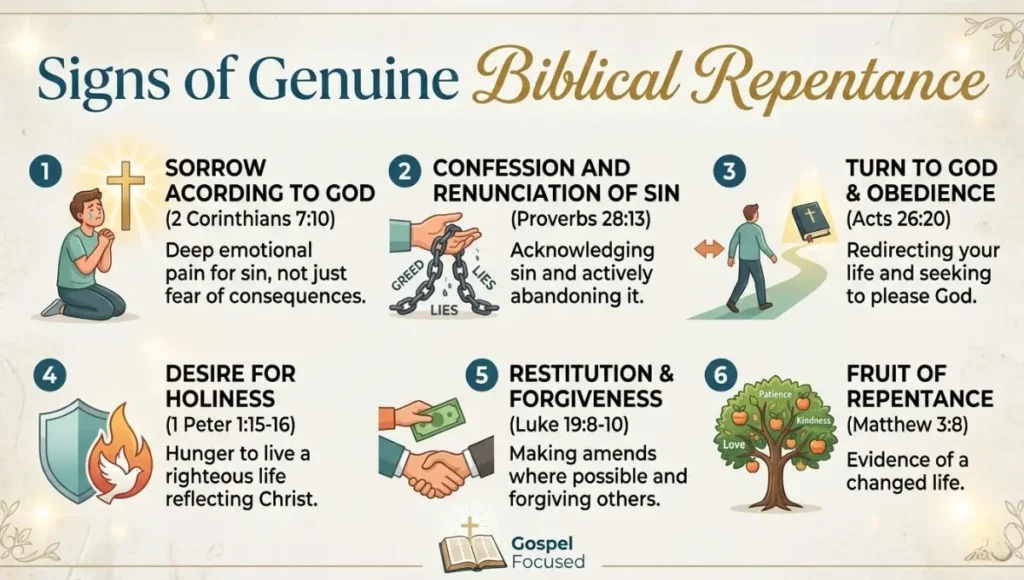
Many people feel regret over sin without truly repenting. The Bible gives clear signs of genuine repentance so we can examine our own hearts honestly.
Repentance is not a mechanical duty but rather a heartfelt, sorrowful response to the conviction of sin (2 Corinthians 7:10). It involves grief over sin and the damage it caused, plus a decision to change one’s ways and reverse course.
Sign 1 — Godly Sorrow The repentant person grieves, not because they got caught, but because they have offended a holy God. Paul rejoiced when the Corinthians demonstrated what godly sorrow produces: earnestness, eagerness to clear themselves, indignation at sin, alarm, longing, concern, and readiness to see justice done (2 Corinthians 7:11).
Sign 2 — Confession Without Excuse True repentance involves understanding and admitting “I have sinned” — not only before others but also before God. The prodigal son recognized his unworthiness before God and his family and was humbled by his mistakes.
Sign 3 — Changed Behavior Genuinely repentant people humble themselves, grieve the pain they have caused, and demonstrate tangible change. Zacchaeus demonstrated the generosity of his repentance by giving half his possessions to the poor and repaying those he had wronged fourfold.
Sign 4 — Accepting Consequences A genuinely repentant person accepts consequences, including losing the trust of others or relinquishing a position of authority.
Sign 5 — Ongoing Turning from Sin Genuine repentance is seen in the abiding desire and ongoing effort to continually flee from sin by the power of the Spirit.
Repentance and God’s Patience
One of the most reassuring truths in all of Scripture is that God is patient with sinners. He does not instantly judge. He waits, calls, and longs for people to return.
2 Peter 3:9 is the great patience verse: “The Lord is not slack concerning his promise…but is longsuffering to us-ward, not willing that any should perish, but that all should come to repentance.” God’s apparent delay in judgment is not weakness it is mercy.
Ezekiel 33:11 captures God’s emotional plea: “As I live, saith the Lord God, I have no pleasure in the death of the wicked; but that the wicked turn from his way and live: turn ye, turn ye from your evil ways; for why will ye die?” God literally begs people to choose life.
This patience, however, is not permanent. Hebrews 3:15 warns, “Today, if ye will hear his voice, harden not your hearts.” The Bible verses about repentance consistently hold together both the patience of God and the urgency of responding to His call now.
Repentance as a Path to Renewal
Repentance is not the end of the road it is the beginning of a new one. Every Bible verse about repentance connected to renewal reveals that turning from sin opens the door to an entirely new life.
Acts 3:19 links repentance directly to “times of refreshing” from God’s presence. When you genuinely repent, you do not just receive forgiveness you receive a fresh encounter with God Himself.
Repentance brings hope, change, and peace. Repentance opens the door to a new beginning, guiding people to reflect on their actions and choose a better path.
Isaiah 30:15 connects returning to God with inner strength: “In returning and rest shall ye be saved; in quietness and in confidence shall be your strength.” Spiritual renewal is not found in striving it is found in turning back to the Source.
Psalm 51:10–12 shows what renewal looks like: a clean heart, a renewed spirit, the restoration of joy, and a willing spirit to continue walking with God. Repentance and spiritual renewal scriptures always connect the act of turning with the experience of transformation.
Read Also: Tristan Meaning in Bible: Biblical Symbolism, Spiritual Message, and Christian Faith Insight
Repentance and Mercy
Mercy is the backdrop of every call to repentance in Scripture. God would not call people to repent if He were not ready to show mercy the moment they turned.
Isaiah 55:6–7 offers one of the clearest promises of mercy upon repentance: “Seek the Lord while he may be found; call upon him while he is near; let the wicked forsake his way, and the unrighteous man his thoughts; let him return to the Lord, that he may have compassion on him, and to our God, for he will abundantly pardon.”
Joel 2:13 describes the character of the God who waits: “He is gracious and merciful, slow to anger, and of great kindness, and repenteth him of the evil.” The mercy of God is not reluctant it is abundant.
Psalm 103:12 reassures the repentant heart: “As far as the east is from the west, so far hath he removed our transgressions from us.” Repentance and mercy Bible verses consistently show that when God forgives, He forgives completely.
Lamentations 3:40 invites personal reflection: “Let us search and try our ways, and turn again to the Lord.” Searching your heart honestly is the doorway into experiencing God’s mercy firsthand.
Repentance and Transformation
Biblical repentance produces transformation. It is not a momentary feeling it is a permanent redirection of the entire life.
Repentance is not simply repeating words. It is a genuine change of heart that turns away from sin and toward God. “Though your sins are like scarlet, they shall be as white as snow” (Isaiah 1:18).
Romans 12:2 captures the transformation: “And be not conformed to this world: but be ye transformed by the renewing of your mind, that ye may prove what is that good, and acceptable, and perfect, will of God.” The renewed mind is the fruit of genuine repentance.
2 Corinthians 5:17 declares the ultimate result: “Therefore if any man be in Christ, he is a new creature: old things are passed away; behold, all things are become new.” Repentance and transformation in Christ mean you are not just forgiven you are made entirely new.
Repentance and transformation go together because turning from sin is not just about what you stop doing; it is about who you are becoming in Christ.
Repentance and Healing
The Bible directly connects repentance with physical and spiritual healing. When we turn from sin, God brings restoration to the whole person body, soul, and spirit.
2 Chronicles 7:14 ends with a remarkable promise: “I will…heal their land.” The healing of a nation begins with the repentance of its people. What is true nationally is also true personally healing follows repentance.
James 5:16 connects confession and healing: “Confess your faults one to another, and pray one for another, that ye may be healed.” Unconfessed sin creates barriers to healing; repentance removes those barriers.
Jeremiah 3:22 links repentance with healing backsliding: “Return, ye backsliding children, and I will heal your backslidings.” God specializes in healing the wounds that sin creates, and repentance is the doorway into that healing.
The Bible verses about repentance and healing remind us that God’s concern is always for the total restoration of the person not just the legal forgiveness of sins.
Repentance and Forgiveness
Repentance and forgiveness are inseparable in Scripture. You cannot fully receive forgiveness without repentance, and you cannot truly repent without receiving forgiveness.
1 John 1:9 is the promise every repentant believer stands on: “If we confess our sins, he is faithful and just to forgive us our sins, and to cleanse us from all unrighteousness.” The faithfulness of God means this promise never fails.
Acts 3:19 encapsulates the biblical message of repentance, linking it to forgiveness and the experience of spiritual renewal: “Repent, then, and turn to God, so that your sins may be wiped out, that times of refreshing may come from the Lord.”
Isaiah 44:22 uses a beautiful image of forgiveness: “I have blotted out, as a thick cloud, thy transgressions, and, as a cloud, thy sins: return unto me; for I have redeemed thee.” God does not hold a grudge He blots out sin completely.
Scriptures about repentance and forgiveness from both Old and New Testaments consistently tell the same story: turn to God, and He will forgive.
Repentance Through Humility
Humility is not optional in biblical repentance it is foundational. You cannot truly repent while remaining proud.
2 Chronicles 7:14 begins with humility: “If my people…shall humble themselves.” Humility before God is the first posture of the repentant heart.
The prodigal son realized that when he repented and returned to his father, he would not automatically regain everything he had lost. He was willing to accept even the discipline of greater limitations he simply desired to be restored, even as a servant. That is true humility before God.
James 4:6 reminds us: “God resisteth the proud, but giveth grace unto the humble.” Repentance through humility is the path to receiving grace. Pride keeps people from repenting; humility opens the floodgates of God’s mercy.
Psalm 51:17 confirms this: “The sacrifices of God are a broken spirit: a broken and a contrite heart, O God, thou wilt not despise.” God never turns away a genuinely humble, repentant heart.
Repentance and Spiritual Cleansing
Every Bible verse about repentance that touches on spiritual cleansing reveals that God’s goal is not just to pardon sin but to wash it away completely.
Psalm 51:2 cries out: “Wash me thoroughly from mine iniquity, and cleanse me from my sin.” David did not ask for partial cleansing he asked for thorough cleansing. God’s answer is always yes to that prayer.
1 John 1:9 promises cleansing “from all unrighteousness” not some, not most, but all. Repentance and spiritual cleansing means coming before God with every sin, every failure, and every stain, and trusting Him to make you entirely clean.
Isaiah 1:16 commands this proactively: “Wash you, make you clean; put away the evil of your doings from before mine eyes.” Repentance is not passive it involves active cooperation with what God is doing in your heart.
The Holy Spirit is the agent of spiritual cleansing in the New Testament. True repentance is connected to a “godly grief” that we have rebelled against God (2 Corinthians 7:9). That grief, when surrendered to God, is what produces deep and lasting cleansing.
Repentance and Restoration
After repentance comes restoration. God never leaves a repentant person in the place of their failure He restores them.
Jeremiah 15:19 states clearly: “If you repent, I will restore you that you may serve me; if you utter worthy, not worthless, words, you will be my spokesman.” The connection between repentance, restoration, and service to God is unmistakable.
The story of Peter is one of the most powerful pictures of repentance and restoration. After Peter denied Jesus three times, Jesus appeared after His resurrection and gave Peter an opportunity to be restored in relationship.
Three times Jesus asked “do you love me?” and each time Jesus gave Peter a new assignment. Peter’s true repentance and obedience meant his relationship with Jesus was fully restored.
Joel 2:25 carries God’s magnificent promise: “And I will restore to you the years that the locust hath eaten.” Repentance does not just stop future loss God can restore what sin has already stolen.
Repentance and restoration through Scripture remind us that God is always in the business of rebuilding lives, marriages, families, and destinies that sin has damaged.
Repentance and Returning to the Right Path

Sin always leads away from God and away from purpose. Repentance is the act of turning around and walking back toward both.
Proverbs 14:12 warns: “There is a way which seemeth right unto a man, but the end thereof are the ways of death.” That wrong path always requires repentance to leave.
Isaiah 30:21 gives the promise of guidance after returning: “And thine ears shall hear a word behind thee, saying, This is the way, walk ye in it, when ye turn to the right hand, and when ye turn to the left.” When you repent and return, God actively directs your steps.
Hosea 14:4 captures the heart of God toward those who return: “I will heal their backsliding, I will love them freely: for mine anger is turned away from him.” Returning to the right path is not just geographically correct it is the path of God’s love and provision.
The Bible verses about repentance and returning consistently paint a picture of a Father who runs toward His returning child, not away from him.
Repentance and Wisdom
The wise person recognizes sin quickly and turns from it without delay. Repentance is not only a spiritual act it is also an act of wisdom.
Proverbs 28:13 is blunt: “He that covereth his sins shall not prosper: but whoso confesseth and forsaketh them shall have mercy.” Covering sin is foolish; confessing it is wise. The repentant person chooses mercy over pride.
Ecclesiastes 7:20 acknowledges the universal need: “For there is not a just man upon earth, that doeth good, and sinneth not.” Wisdom says that because sin is universal, repentance must be a regular practice, not a one-time event.
Lamentations 3:40 invites wisdom-led self-examination: “Let us search and try our ways, and turn again to the Lord.” Wise people regularly examine their hearts, identify where they have drifted from God, and return without hesitation.
Repentance and wisdom in Scripture always go together because foolishness says “I don’t need to change” while wisdom says “I need to return to God.”
Repentance and Grace
Grace is what makes repentance possible and what receives repentance when it is offered. Without grace, there would be no point in repenting God would have no reason to accept us back.
The Bible teaches that it is God’s invitation to experience forgiveness and restoration: “Repentance is not meant to shame us. It is God’s invitation to experience forgiveness and restoration.”
Ephesians 2:8–9 establishes the foundation: “For by grace are ye saved through faith; and that not of yourselves: it is the gift of God.” Even the ability to repent is a gift of grace. Repentance is a necessary but graciously-given prerequisite for salvation.
2 Timothy 2:25 makes this even clearer: “If God peradventure will give them repentance to the acknowledging of the truth.” God grants repentance it is a grace given to those who seek Him.
Titus 2:11 reminds us: “For the grace of God that bringeth salvation hath appeared to all men.” Grace is available to every person. The Bible verses about repentance and grace together declare that no one is beyond the reach of God’s forgiving love.
Repentance and Inner Change
External behavior always follows internal transformation. True repentance begins in the deepest part of a person the heart.
Joel 2:13 draws the contrast clearly: “Rend your heart, and not your garments.” In the ancient world, tearing one’s clothes was a sign of mourning or repentance. But God says He is not interested in the outward show He wants the inner reality.
Ezekiel 18:31 commands: “Cast away from you all your transgressions, whereby ye have transgressed; and make you a new heart and a new spirit.” The inner change must be genuine and complete.
Ezekiel 36:26 is God’s promise of inner transformation: “A new heart also will I give you, and a new spirit will I put within you: and I will take away the stony heart out of your flesh, and I will give you an heart of flesh.” Repentance and inner change are possible because God Himself performs the deepest work.
The repentant heart is not self-manufactured it is God-given. Repentance opens the heart to receive what only God can do.
Repentance Leads to Peace
Sin creates turmoil. Repentance brings peace. This is one of the most consistent promises attached to turning from sin in all of Scripture.
Isaiah 57:21 warns: “There is no peace, saith my God, to the wicked.” But for those who turn to God, peace is the inheritance. Isaiah 26:3 declares: “Thou wilt keep him in perfect peace, whose mind is stayed on thee: because he trusteth in thee.”
Psalm 32:1–5 shows the contrast vividly. Before confession, David’s “bones waxed old” through his roaring all day long. After confession, the weight lifted completely. Repentance brought him back to the place of peace.
Romans 5:1 connects repentance, justification, and peace: “Therefore being justified by faith, we have peace with God through our Lord Jesus Christ.” Repentance is the gateway into this peace a settled peace with God that the world cannot give or take away.
The Bible verses about repentance leading to peace remind every struggling soul that the peace they are searching for is waiting on the other side of turning to God.
Repentance and Responsibility
True repentance takes responsibility for sin without blame-shifting or excuse-making. The repentant person says, “I have sinned” not “I sinned because of…”
Nehemiah’s repentance prayer in Nehemiah 1:6–7 is a model: “I confess the sins of the children of Israel, which we have sinned against thee: both I and my father’s house have sinned.” Nehemiah did not excuse the sin he owned it on behalf of his people.
Daniel 9:5–6 is another example of corporate repentance with full accountability: “We have sinned, and have committed iniquity, and have done wickedly, and have rebelled, even by departing from thy precepts and from thy judgments.”
Those who fail often blame other people or circumstances. True repentance involves understanding and admitting “I have sinned” not only before others but also before God.
Repentance and responsibility in Scripture always go together because God never accepts excuses in place of confession. Responsibility is the first step back to restoration.
Repentance and Hope
Every act of genuine repentance carries within it a seed of hope. When you turn to God, you are turning toward the One who holds your future.
Jeremiah 29:11 is the hope verse for every repentant heart: “For I know the thoughts that I think toward you, saith the Lord, thoughts of peace, and not of evil, to give you an expected end.” Turning to God means turning toward His good plans for your life.
Lamentations 3:22–23 grounds hope in God’s character: “It is of the Lord’s mercies that we are not consumed, because his compassions fail not. They are new every morning: great is thy faithfulness.” New mercy is available every single morning to the repentant heart.
Repentance brings hope, change, and peace. When we repent, God brings hope and a fresh beginning. His mercy is greater than our mistakes.
Repentance and hope are always linked in Scripture because God never calls someone to turn around just to leave them standing in the middle of nowhere He calls them to turn toward His arms.
Repentance and a Changed Heart
The heart is the center of everything in biblical repentance. God is not satisfied with behavioral modification He demands and produces heart transformation.
Deuteronomy 30:6 contains one of the earliest promises of a changed heart: “And the Lord thy God will circumcise thine heart, and the heart of thy seed, to love the Lord thy God with all thine heart, and with all thy soul, that thou mayest live.”
Psalm 51:10 captures the prayer: “Create in me a clean heart, O God; and renew a right spirit within me.” The word “create” (bara in Hebrew) is the same word used for God’s creation in Genesis. A changed heart is a creative act of God.
Jeremiah 24:7 holds the promise: “And I will give them an heart to know me, that I am the Lord: and they shall be my people, and I will be their God: for they shall return unto me with their whole heart.”
Repentance and a changed heart are the evidence that God has truly worked. The changed heart does not simply avoid sin it desires God.
Repentance and Obedience
Repentance is not complete until it moves from the heart into the hands and feet. Biblical repentance always results in obedience.
Acts 26:20 sets the standard clearly: those who repented “should repent and turn to God, and do works meet for repentance.” Works of repentance are works of obedience tangible, visible changes in behavior.
1 Samuel 15:22 establishes the priority: “Behold, to obey is better than sacrifice, and to hearken than the fat of rams.” God is not impressed with religious acts divorced from obedience. Repentance that does not produce obedience is incomplete.
John 14:15 links love with obedience: “If ye love me, keep my commandments.” When repentance produces a genuine love for God, obedience naturally follows. You do not obey to earn forgiveness you obey because you have been forgiven and your heart has changed.
The Bible verses about repentance and obedience remind us that repentance is not a private spiritual feeling. It is a public commitment to walk differently.
Repentance and Life Direction
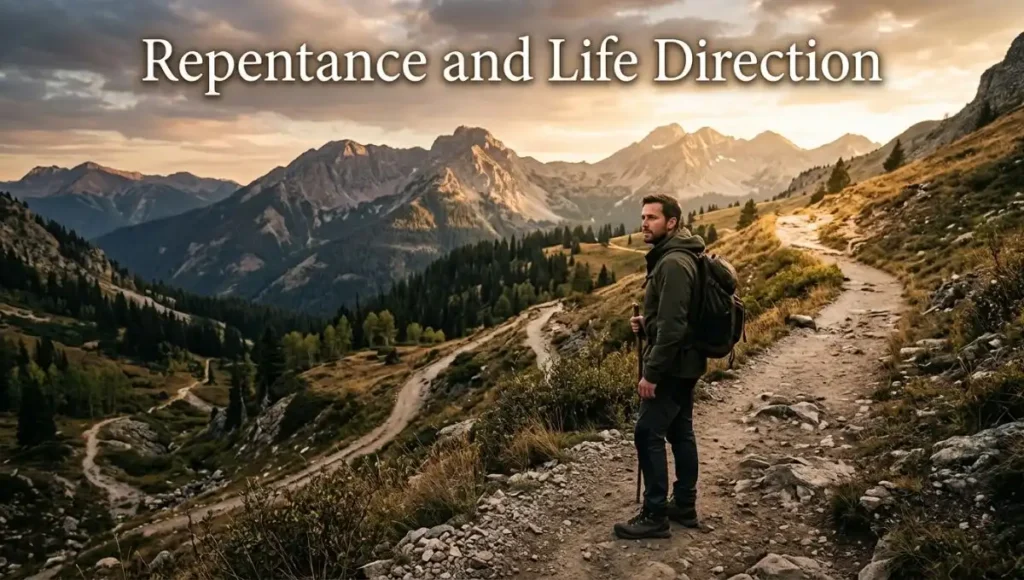
Sin pulls a person in one direction. Repentance pulls them in the opposite direction. Every turning in Scripture is also a redirecting of life purpose and direction.
Deuteronomy 30:19 frames the choice starkly: “I have set before you life and death, blessing and cursing: therefore choose life.” Repentance is choosing life not just in the eternal sense but in the daily direction of living.
Isaiah 55:6 adds urgency to the choice of direction: “Seek ye the Lord while he may be found, call ye upon him while he is near.” Direction matters, and the time to change course is always now.
Proverbs 3:5–6 shows what happens when you commit your direction to God: “Trust in the Lord with all thine heart; and lean not unto thine own understanding. In all thy ways acknowledge him, and he shall direct thy paths.” Repentance and life direction are connected turning to God means trusting Him to lead.
Repentance and Spiritual Growth
Repentance is not a one-time event in the Christian life it is an ongoing practice that drives continual spiritual growth.
Hebrews 6:1 calls repentance a foundational doctrine: “Not laying again the foundation of repentance from dead works.” But it is a foundation to build upon, not one to remain stuck on. Growth happens as we repent, receive grace, and move forward.
Philippians 3:13–14 captures the growth mindset after repentance: “Forgetting those things which are behind, and reaching forth unto those things which are before, I press toward the mark.” Repentance releases the weight of the past so you can run freely into God’s future.
The primary dimension of repentance is a moral one that results in individuals turning back to the law of God in order to share in His holy character. Every act of repentance makes you more like God and becoming more like God is the definition of spiritual growth.
How repentance leads to spiritual growth and peace is one of the most practical questions of the Christian life. The answer is this: every time you repent, you remove a barrier between yourself and God, and every removed barrier lets more of His life flow into yours.
Repentance and Strength
Many people think repentance is a sign of weakness. The Bible teaches the opposite repentance requires and produces extraordinary spiritual strength.
Isaiah 30:15 contains one of the most counterintuitive promises in Scripture: “In returning and rest shall ye be saved; in quietness and in confidence shall be your strength.” True strength in the Christian life does not come from striving it comes from returning to God.
Psalm 27:14 encourages the repentant heart to “wait on the Lord: be of good courage, and he shall strengthen thine heart.” Repentance positions you to receive strength the very strength of God Himself.
Ephesians 6:10 speaks to this reality: “Be strong in the Lord, and in the power of his might.” The strength that flows from repentance is not your own it is divine strength made available to those who have cleared the path through repentance and faith.
FAQs (Bible Verses About Repentance)
What does repentance mean in the Bible?
Repentance in the Bible means a genuine turning away from sin and returning to God not just feeling sorry, but completely changing the direction of your heart, mind, and life.
How many Bible verses about repentance are there?
There are hundreds of direct and indirect references to repentance throughout Scripture, spanning both the Old and New Testaments, with strong concentrations in the Psalms, Prophets, Gospels, and Acts.
What is the most powerful Bible verse about repentance?
Acts 3:19 is among the most powerful: “Repent ye therefore, and be converted, that your sins may be blotted out, when the times of refreshing shall come from the presence of the Lord.”
What does repentance look like in daily Christian life?
Daily repentance means quickly acknowledging sin when convicted by the Holy Spirit, confessing it to God, and actively turning away from it keeping your relationship with God clear and unhindered.
Is repentance required for salvation?
Yes the Bible repeatedly calls people to repent and believe the gospel together. Mark 1:15 says “Repent ye, and believe the gospel.” Both repentance and faith are essential responses to God’s grace.
What is the difference between remorse and true repentance?
Remorse is sorrow over consequences; true repentance is sorrow over offending God, followed by a genuine change of direction. 2 Corinthians 7:10 describes it as “godly sorrow” versus “worldly sorrow.”
Can God forgive any sin if someone repents?
Yes — Isaiah 1:18 promises, “Though your sins be as scarlet, they shall be as white as snow.” No sin is beyond the reach of God’s forgiveness when met with genuine repentance.
What Old Testament book has the most about repentance?
Ezekiel and Isaiah both contain some of the most concentrated teachings on repentance, along with the Psalms, particularly Psalm 51, which is the defining individual repentance prayer.
How does repentance lead to peace?
Repentance removes sin’s barrier between you and God. Romans 5:1 says, “Being justified by faith, we have peace with God through our Lord Jesus Christ.” Restored relationship with God produces lasting peace.
What are signs of genuine repentance according to the Bible?
Genuine repentance includes godly sorrow over sin, full confession without excuse, visible change in behavior, acceptance of consequences, and an ongoing turning away from sin by the power of the Holy Spirit.
Conclusion (Bible Verses About Repentance)
The Bible verses about repentance gathered in this article tell one unified, glorious story: God loves people too much to leave them in their sin, and He calls every person regardless of how far they have fallen to turn around and come home.
From the passionate plea of Ezekiel 18:32 — “Repent and live!” to the welcoming promise of Acts 3:19 — “times of refreshing shall come from the presence of the Lord” Scripture makes it unmistakably clear that repentance is not a burden. It is a gift. It is the door to forgiveness, healing, restoration, peace, and eternal life.
The best Bible verses about repentance are not simply words to read they are invitations to respond. If you have been running from God, today is the day to stop running and turn toward Him. He is not waiting with anger He is waiting with open arms and the promise of abundant pardon.
True repentance leads to salvation, spiritual renewal, inner transformation, and a changed heart that walks with God every day. That is not religion that is the life God created you to live.
“Return unto me, and I will return unto you, saith the Lord of hosts.” — Malachi 3:7

Abdul Mannan Haider is a content writer at [InspiredMsg.com], specializing in Messages and Prayers. With 5 years of experience, he creates meaningful, engaging, and easy-to-read content that connects with readers.
![110 Romantic And Heart Touching Apology Message To My Love [Him or Her]](https://inspiredmsg.com/wp-content/uploads/2026/10/110-Romantic-And-Heart-Touching-Apology-Message-To-My-Love-Him-or-Her-300x170.webp)