Grief has a way of silencing us at the very moment someone needs our voice the most. You want to reach out, but the words feel hollow or risky. What if the theological framing doesn’t match their beliefs? What if you say the wrong thing?
Here is the truth: condolence religious messages delivered with genuine care will always mean more than silence. Sending thoughtful condolence religious messages is one of the most meaningful acts of faith a community can offer.
This complete guide gives you 81 carefully crafted, faith-informed condolence religious messages organized by religion, grief stage, tone, and occasion so you can offer spiritual comfort with real confidence.
Whether you are writing a sympathy card, sending a quick text, or composing a formal letter, these condolence religious messages are ready to use, adapt, and personalize for any tradition.
Immediate Strength: Short Religious Condolence Messages for Texts and Cards
When loss first strikes, brevity carries the most weight. A short, sincere condolence religious message sent within the first 24 hours provides an anchor of human presence during the most disorienting hours of grief.
These condolence religious messages work beautifully in texts, sympathy cards, and brief social media notes.
Well-chosen condolence religious messages sent promptly can become a memory the bereaved family carries for years. The goal of condolence religious messages at this stage is not eloquence it is presence.
Short Christian Sympathy Messages (Faith-Centered)
Christian condolence religious messages draw from a rich tradition of grace, hope, and the promise of eternal life. These short examples carry genuine theological weight without overwhelming the reader.
- “May the peace of God, which passes all understanding, guard your heart today. Praying for you.”
- “Holding you and your family in prayer. May the Lord be your strength and your comfort.”
- “Heaven has gained a beautiful soul. May God wrap His arms around you during this painful time.”
- “Your loved one is now at rest in the arms of Jesus. Thinking of your family with love and prayer.”
- “God is close to the brokenhearted. Know that He is near you today and always.” (Psalm 34:18)
- “May the Lord be your shepherd through the valley of this grief, as He has promised.” (Psalm 23)
- “Trusting that God holds your loved one safely in His eternal love. Praying without ceasing for your family.”
These short Christian condolence religious messages are ideal for sympathy cards, quick texts, or as an opening line in a longer letter. They acknowledge both the pain of loss and the hope found in faith which is exactly what grieving believers need to hear.
Messages Focused on Prayer and Practical Support
Sometimes a condolence religious message is most powerful when it combines spiritual comfort with a concrete offer of support. The most remembered condolence religious messages are those that led to real action. Grief is not only spiritual it is also logistical and exhausting. These faith-based sympathy messages bridge both realities.
- “I am lifting you up in prayer every morning. Please let me know what I can do meals, errands, just sitting with you.”
- “Praying that God sends you exactly the help you need today. I am one phone call away.”
- “My prayers are with you. And so are my hands please tell me how I can show up for your family.”
- “I have been offering condolence religious messages for years, but for your family I simply want to say: I am here. Praying, and ready to act.”
- “God often works through people. I would love to be part of how He shows up for you this week.”
These condolence religious messages acknowledge that divine comfort frequently arrives through human hands and that your offer of presence is itself a form of prayer.
Interfaith and Universal Spiritual Comfort (Non-Denominational)
When you are unsure of the grieving person’s specific denomination or faith background, interfaith condolence religious messages that speak to a broader divine love are both respectful and deeply comforting. These universal condolence religious messages avoid denominational assumptions while still honoring the sacred dimension of loss.
- “May a higher power surround your family with peace and guide you through the days ahead.”
- “There is a love greater than grief. May you feel it carrying you through this time.”
- “May your spirit find rest and your heart find healing in the divine mercy that never fails.”
- “Whatever you believe about what comes after, the love you shared is permanent and real. Nothing can take that from you.”
These interfaith condolence religious messages are especially useful in multicultural workplaces, diverse communities, and when reaching out to acquaintances whose specific beliefs you may not know well.
Deep, Brief Bible Verses for Sympathy Cards
A single Bible verse for condolences can speak volumes when your own words feel inadequate. These are theologically rich yet accessible perfect for a sympathy card insert, a handwritten note, or a text alongside a personal condolence religious message.
- “The Lord is close to the brokenhearted and saves those who are crushed in spirit.” — Psalm 34:18
- “Blessed are those who mourn, for they will be comforted.” — Matthew 5:4
- “He will wipe every tear from their eyes. There will be no more death or mourning or crying or pain.” — Revelation 21:4
- “I am the resurrection and the life. Whoever believes in me, though he die, yet shall he live.” — John 11:25
- “Cast all your anxiety on him because he cares for you.” — 1 Peter 5:7
- “The Lord gives and the Lord takes away. Blessed be the name of the Lord.” — Job 1:21
These Bible-based condolence religious messages are universally respected across Protestant and Catholic traditions, making them a safe and meaningful choice for almost any Christian family. A scripture-grounded condolence religious message carries authority that personal words alone cannot achieve.
Theology of Lasting Comfort: Messages for Specific Grief Milestones

Grief does not end after the funeral. The hardest moments often come weeks and months later, when the world has moved on but the loss remains raw. Thoughtful condolence religious messages sent at key grief milestones can provide lasting spiritual support.
For Doubt and Anguish: Acknowledging Pain While Holding Hope
One of the greatest mistakes in comforting words after death is rushing the grieving person toward acceptance. Doubt, anger, and anguish are valid parts of faith-based grief. These condolence religious messages meet people in that difficult emotional space without rushing them out of it.
- “It is okay to ask God why. He can handle your questions and your anger. Your faith doesn’t require you to feel peace right now.”
- “Even the Psalms cry out in anguish. Your grief is not a failure of faith it is proof of how deeply you loved.”
- “God is not offended by your tears or your confusion. He mourned too, at the tomb of Lazarus. Weep freely.”
- “You don’t have to feel hopeful today. Just hold on, and let others carry the hope for you while you grieve.”
- “I am not sending you a condolence religious message to fix your grief. I am sending it so you know I see it.”
These condolence religious messages honor the complexity of faith under pressure they don’t minimize real pain with premature reassurance. Honest, doubt-acknowledging condolence religious messages often mean far more than triumphant ones.
Focusing on Eternal Peace and Reunion
For families who find deep comfort in the theology of eternal life and heavenly reunion, these condolence religious messages point toward enduring hope without dismissing present sorrow. Resurrection-centered condolence religious messages are among the most powerful tools a believer can offer.
- “Death for a believer is not a goodbye it is the beginning of a reunion that will never end. Your loved one is waiting.”
- “They have stepped out of time and into eternity. The separation you feel is real, but it is not permanent.”
- “One day the door will open and you will see them again, more fully and joyfully than you ever could here. Until then, God holds them for you.”
- “Heaven is not a place of forgetting it is a place of being fully known. They are not lost to you.”
These eternal peace condolence religious messages draw on the central promise of resurrection hope one of the most theologically profound forms of comfort available within faith traditions.
Messages for Profound or Tragic Loss
When loss is sudden, violent, or involves a child, the standard condolence religious message falls impossibly short. These words sit with the tragedy rather than trying to explain it.
- “There are no words for this kind of loss. I will not try to explain what cannot be explained. I am simply here, and I am praying.”
- “I do not know why this happened. But I know that God does not abandon us in tragedies He enters them with us.”
- “A life this brief was still infinitely precious to God and to everyone who knew them. Nothing about that love is lost.”
- “In the face of something this devastating, faith does not give us answers it gives us a hand to hold. I am holding yours.”
These condolence religious messages for tragic circumstances acknowledge mystery without minimizing it which is the most honest and compassionate thing you can offer. When standard condolence religious messages fall short, silence-breaking presence carries the message.
Read Also: 70 Funny Get Well Messages After Surgery
Faith-Specific Condolence Religious Messages: Depth and Respect
Generic condolence religious messages work in a pinch, but when you know someone’s specific tradition, faith-specific wording signals genuine respect.
Faith-specific condolence religious messages tell the bereaved family that their identity and beliefs have been honored. The most powerful condolence religious messages are always the most specific ones.
If you have time to personalize only one element of your condolence religious messages, choose specificity over length. It tells the grieving family that you took real time to honor who they are and what they believe.
Islamic Condolence Messages (Ta’ziyah) and Context
In Islam, offering condolences is called Ta’ziyah — a sacred act of mercy and communal care. The foundational phrase for all Islamic condolence religious messages comes directly from the Quran, Surah Al-Baqarah (2:156):
Inna lillahi wa inna ilayhi raji’un — “Indeed, we belong to Allah, and indeed to Him we shall return.”
This is not merely a cultural expression — it is an act of worship, a reminder that life belongs to Allah and death is a return to Him. Every strong Islamic condolence religious message should contain or be grounded in this affirmation.
Practical Ta’ziyah condolence religious messages:
- “Inna lillahi wa inna ilayhi raji’un. May Allah grant your loved one Jannat ul Firdaus and ease your heart with His mercy.”
- “May Allah grant you sabr (patience) during this time of immense pain. You are in our duas.”
- “May Allah forgive the departed, expand their grave, and illuminate it with His light. And may He be your strength, Ameen.”
- “Inna lillahi wa inna ilayhi raji’un. They returned to the Most Merciful. May that truth bring you some peace in this season of grief.”
- “May Allah accept their good deeds, shower them with His mercy, and grant your family the patience to carry this loss.”
- “O Allah, forgive him and have mercy upon him, pardon him and grant him peace.” (Allahumma ighfir lahu warhamhu)
Important Islamic context: According to Islamic tradition, Ta’ziyah condolence religious messages are ideally offered within three days of the death. It is also Sunnah prophetic tradition to prepare and deliver food to the grieving family, as the Prophet Muhammad (PBUH) encouraged after the passing of Ja’far ibn Abi Talib.
Dua phrases for the deceased (appropriate to include in written condolence religious messages):
- Allahumma aj’al qabrahu rawdatan min riyadil jannah — “O Allah, make their grave a garden from the gardens of Paradise.”
- Allahumma wassi’ mudkhalahu wa nawwir qabrahu — “O Allah, expand their entrance and illuminate their grave.”
Jewish Messages of Comfort (Shivah) and Meaning
Jewish mourning is profoundly communal. The seven-day Shivah period is a time when the community literally surrounds the bereaved bringing food, sitting in silence or in shared remembrance, offering presence over polished words.
The traditional phrase of comfort is HaMakom y’nachem etchem b’toch sh’ar avlei Tzion v’Yerushalayim — “May God comfort you among the mourners of Zion and Jerusalem.”
The most universally known Jewish condolence phrase is Zichrono livracha (for a man) or Zichrona livracha (for a woman) — “May their memory be a blessing.” Rooted in Proverbs 10:7, this phrase carries enormous cultural and spiritual weight. Any condolence religious message sent to a Jewish family is strengthened by including it.
Shivah-appropriate condolence religious messages:
- “Zichrono livracha. Your father’s memory is already a blessing I feel it every time I think of him.”
- “May the One who creates peace on high bring peace to you and to all Israel.”
- “HaMakom y’nachem etchem. May you be comforted among all who mourn.”
- “May her memory be a source of light for your family for generations to come.”
- “Baruch Dayan HaEmet. Blessed is the True Judge. Our hearts are with you as you carry this.”
- “The memory of the righteous is a blessing. [Name] was truly one of the good ones.”
Important note on Jewish condolence religious messages: Before writing a Jewish condolence religious message, keep this in mind: Jewish mourning theology centers the living mourner more than assertions about the afterlife. Your condolence religious message is most effective when it focuses on memory, community, and the concrete presence of those who loved the deceased.
Catholic and Denominational Christian Condolence Wording
Catholic condolence religious messages carry unique denominational weight. These condolence religious messages often reference specific sacramental elements the Mass, eternal rest, the intercession of saints that are meaningful within the tradition but unfamiliar outside it. When writing to a Catholic family, these references honor their specific theological framework.
- “We will offer a Mass in [Name]’s memory. May God grant them eternal rest and let perpetual light shine upon them.”
- “Eternal rest grant unto them, O Lord, and let perpetual light shine upon them. May they rest in peace.”
- “May Our Lady of Sorrows comfort your family as only she can. You are in our rosary intentions.”
For Protestant or Evangelical families, your condolence religious message should center on scripture, personal faith, and the assurance of salvation:
- “Because of Christ’s resurrection, we do not grieve as those who have no hope. We will see them again.” (1 Thessalonians 4:13)
- “Your loved one finished the race faithfully. They have heard the words: ‘Well done, good and faithful servant.'” (Matthew 25:23)
- “May the same God who raised Christ from the dead raise your spirit and sustain your hope today.”
Cultural Expressions of Sympathy in Religious and Spiritual Traditions
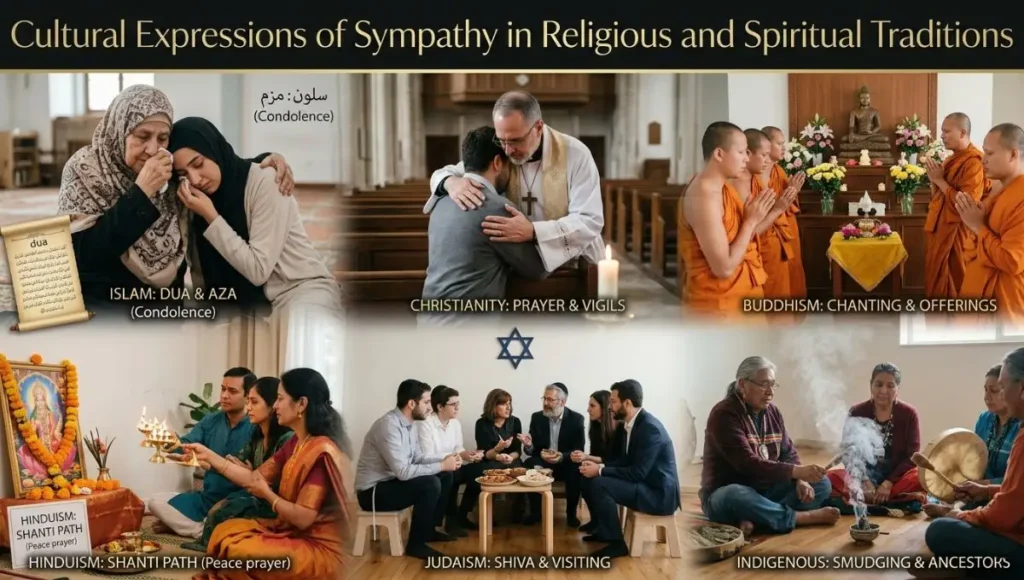
Condolence religious messages vary widely across cultures, and understanding those differences can transform a kind gesture into a profoundly meaningful act of respect.
Hindu tradition emphasizes the soul’s ongoing journey the Atman continues beyond the body. Condolence religious messages may reference moksha (liberation): “May their soul find moksha and rest in divine peace. Om Shanti.”
Buddhist tradition centers on impermanence and compassionate release: “May they be free from suffering. May your family find peace in the understanding that love transcends impermanence.”
Sikh tradition uses Waheguru Ji Ka Khalsa, Waheguru Ji Ki Fateh and refers to the soul’s return to God. A respectful condolence religious message: “May Waheguru grant your family strength, and may their soul rest in eternal peace in His presence.”
African diaspora Christian traditions often emphasize communal mourning, singing, and the continuation of the ancestors’ legacy in the living community.
When sending condolence religious messages across cultural lines, the guiding principle is simple: honor what they believe, not what you assume they believe. Culturally aware condolence religious messages demonstrate that your sympathy is genuine, not generic. They also show the bereaved that sending condolence religious messages was a deliberate act of love, not a routine obligation.
Acts of Compassion: How to Support Grieving Families Beyond Messages
A meaningful condolence religious message is just the beginning. Condolence religious messages open the door your ongoing presence keeps it open. Every major faith tradition emphasizes that words must be accompanied by action. Here is how to translate spiritual condolence into practical love:
Prepare and deliver food. In Islam, this is Sunnah. In Jewish tradition, the first meal after burial is provided by the community (seudat havra’ah). In most Christian cultures, bringing food is a love language that speaks louder than any card.
Show up physically. Sitting shivah means literally sitting with mourners. Many condolence religious messages are forgotten, but physical presence is remembered for years.
Follow up after the funeral. Grief intensifies in the weeks after the ceremony, when support from others typically drops away. A condolence religious message sent three weeks or three months later may be the one they remember most.
Offer specific, actionable help. Replace “Let me know if you need anything” with “I am bringing dinner Thursday. Does 6 PM work?” Specificity removes the burden of asking from someone already overwhelmed by loss.
Pray consistently and tell them. A follow-up text “You are still in my prayers today” — costs nothing and means everything. These small, ongoing condolence religious messages sustained across weeks of grief form a spiritual safety net. Think of it as a ministry of condolence religious messages showing up not once, but faithfully.
Common Mistakes to Avoid in Religious Condolence Messaging
Even the most well-intentioned condolence religious messages can miss the mark. Understanding these errors is as important as crafting the condolence religious messages themselves.
Poorly delivered condolence religious messages can inadvertently deepen grief rather than ease it. Understanding these common errors will help you offer comfort without causing unintended pain.
Saying “It was God’s will.” While theologically grounded in some traditions, saying this immediately after a loss often feels dismissive. It can sound like the grieving person is being told they should not be sad.
Assuming the faith of the bereaved. Never use specifically Catholic, Islamic, or Jewish condolence religious messages unless you are confident of the family’s tradition. Using the wrong religious framework can create distance rather than comfort.
Rushing toward silver linings. Phrases like “at least they lived a long life” or “everything happens for a reason” minimize grief. Cleveland Clinic research confirms that these silver-lining phrases are among the most frequently reported as hurtful by bereaved people.
Making the message about yourself. Avoid centering your own grief: “I know how you feel when my mother died…” Keep your condolence religious message focused entirely on the family you are comforting.
Overusing autopilot phrases. “Thoughts and prayers” has become so reflexive that it carries almost no meaning. If you truly pray for the family, say what you pray for. Specificity transforms a cliché into a genuine condolence religious message.
Projecting religious comfort onto non-believers. If you do not know whether the bereaved family is religious, default to warm human language. Reserve condolence religious messages for those for whom faith is a source of genuine comfort.
How to Deliver Your Religious Message with Sincerity

The wording of your condolence religious message matters but so does the delivery. Heartfelt condolence religious messages lose their power when they are delivered impersonally or at the wrong moment.
How you frame, open, and close a message determines whether it lands as genuine comfort or polite obligation.
Structuring the Sympathy Card Message (Formal)
A well-structured condolence religious message follows a simple three-part framework that applies across all faith traditions:
1. Acknowledge the loss directly. Name the person who died. Say “I was heartbroken to hear of [Name]’s passing” — not “during this difficult time.” Direct acknowledgment is the most humanizing way to open any condolence religious message.
2. Offer your faith-based comfort. This is where your scripture, dua, Jewish phrase, or spiritual sentiment belongs — always calibrated to the recipient’s tradition.
3. Close with an offer of presence. “We are here for your family” or “You are surrounded by love and prayer” closes the condolence religious message with warmth and genuine openness.
A complete example: “I was heartbroken to hear of your mother’s passing. May God’s peace, which surpasses all understanding, guard your heart and mind during this time (Philippians 4:7). Our family is praying for yours, and we are here for whatever you need.”
The Crucial Art of the Opening and Closing
The opening line of your condolence religious message sets the entire emotional tone. Avoid starting with “I” — it subtly centers yourself. Begin with the bereaved person or the loss.
Strong openings for condolence religious messages:
- “Your family is in our prayers…”
- “The news of [Name]’s passing deeply moved our hearts…”
- “Words feel insufficient, but we want you to know…”
Strong closings:
- “With love, prayers, and steadfast support…”
- “Holding your family close in our hearts and in our prayers…”
- “May God’s peace be your companion through every difficult day ahead…”
Avoid ending with a standalone “Let me know if you need anything” it places the burden of asking on the grieving person. Close your condolence religious message with open-ended warmth and a specific offer.
When to Avoid Religious Condolence Wording
Not every situation calls for condolence religious messages, even if you are personally devout. Knowing when not to use faith language is just as important as knowing how.
If you do not know whether the family is religious, use neutral human warmth: “I am so sorry for your loss. You are in my thoughts every day.” That is always appropriate.
If the person has previously expressed distance from religion, using prayer-centered condolence religious messages may feel alienating rather than comforting.
If the death involved circumstances that may create complicated feelings about faith sudden tragedy, suicide, estrangement from a faith community lead with empathy and presence before reaching for theological framing.
The guiding principle: condolence religious messages exist to serve the grieving person, not to express your own faith. When in doubt, simpler condolence religious messages rooted in empathy are always the wiser choice.
Frequently Asked Questions
What is the best condolence religious message to send right after a death?
Keep it short, sincere, and specific to their faith. “Praying for you and your family. May God comfort you in this unbearable time” is always appropriate and takes less than ten seconds to send. The best condolence religious message is the one that actually gets sent. Research consistently shows that grieving people value any sincere condolence religious message over no message at all.
Can I use condolence religious messages if I am not religious myself?
Yes what matters is honoring what brings comfort to the bereaved. Say something like “I know how much your faith means to you, and I hope it holds you close right now.” That condolence religious message is sincere, respectful, and genuinely kind.
How do I write a condolence religious message for a Muslim colleague?
Begin with “Inna lillahi wa inna ilayhi raji’un” if you are comfortable, or write “May Allah grant your family patience and peace, and may your loved one rest in His mercy.” Both forms of this condolence religious message are deeply respected in Islamic tradition.
What should I write in a Jewish sympathy card?
“May their memory be a blessing” is the most universally appropriate phrase for any Jewish condolence religious message. You may also use “HaMakom y’nachem etchem” “May God comfort you” the traditional phrase offered during shivah.
Should I include Bible verses in a condolence religious message?
If the family is Christian, yes a single well-chosen verse adds real depth without overwhelming a short card. Psalm 34:18 and Revelation 21:4 are loved across most Christian denominations and strengthen any condolence religious message.
How do I write a condolence religious message after a sudden or tragic death?
Avoid explanations entirely. Focus on presence: “There are no words for this kind of loss. We are here, we are praying, and we are not going anywhere.” That simple condolence religious message is far more comforting than any theological explanation of suffering.
How long should a condolence religious message be?
For a text: one to three sentences. For a sympathy card: three to five sentences. For a formal letter: three short paragraphs. Brevity is not coldness it is respect for the exhausted, overwhelmed state of the bereaved.
Is it appropriate to send condolence religious messages weeks after the death?
Absolutely in fact, it may be even more valuable. Most bereaved people receive immediate support and then experience painful silence in the weeks that follow. A condolence religious message sent one or two months later may be the one they treasure most.
Conclusion
Grief asks very little of us only that we show up. When we offer condolence religious messages grounded in genuine faith, cultural respect, and human warmth, we become part of the divine comfort that every grieving person desperately needs.
There is no perfect message. Every meaningful condolence religious message in history has been written by an imperfect person trying their best. The condolence religious message you send imperfectly, with a trembling hand and a full heart, will almost always mean more than the one you spent days crafting and never delivered. Take these 81 condolence religious messages as tools, not scripts reshape them, add the name of the person who died, mention a specific memory, and make them yours. These condolence religious messages are a starting point; your personal touch turns them into something irreplaceable.
Whether you use Islamic, Jewish, Christian, or universal condolence religious messages whether you write Inna lillahi wa inna ilayhi raji’un, or May their memory be a blessing, or simply “God is with you” — the meaning underneath every condolence religious message is the same: You are not alone. You are seen. You are loved.
That is always the right thing to say.

Abdul Mannan Haider is a content writer at [InspiredMsg.com], specializing in Messages and Prayers. With 5 years of experience, he creates meaningful, engaging, and easy-to-read content that connects with readers.
![110 Romantic And Heart Touching Apology Message To My Love [Him or Her]](https://inspiredmsg.com/wp-content/uploads/2026/10/110-Romantic-And-Heart-Touching-Apology-Message-To-My-Love-Him-or-Her-300x170.webp)